other

blogs

Home

blogs

  • Supermarket Floors: Cleaning Between Trading Hours Without Leaving a Slip Film
    Nov 05, 2026
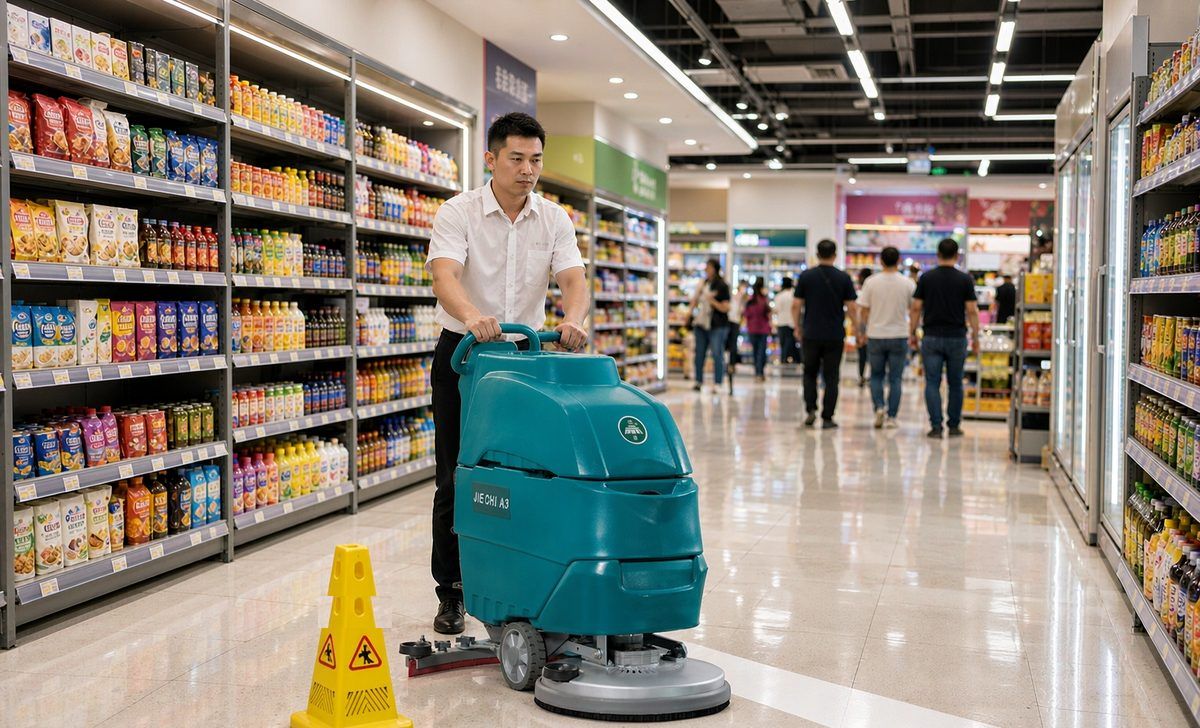
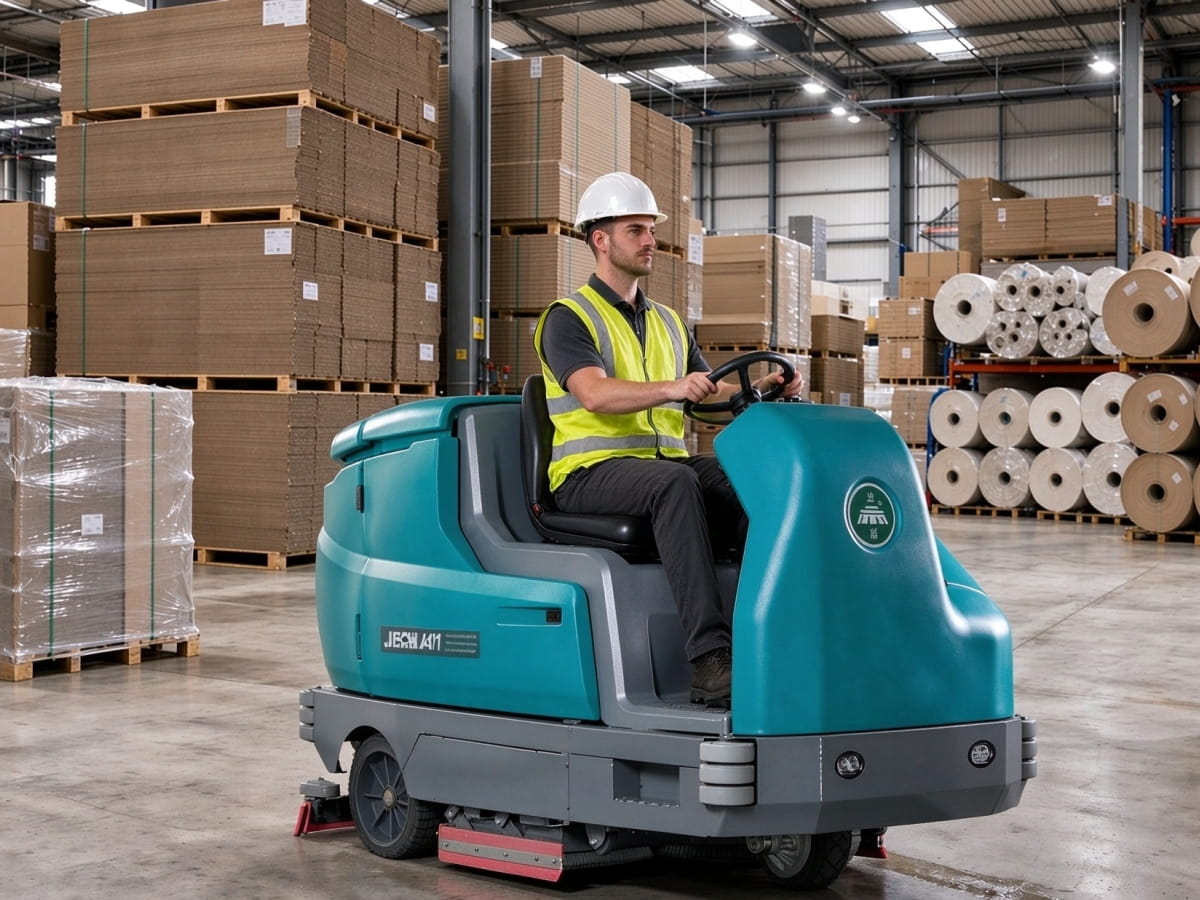
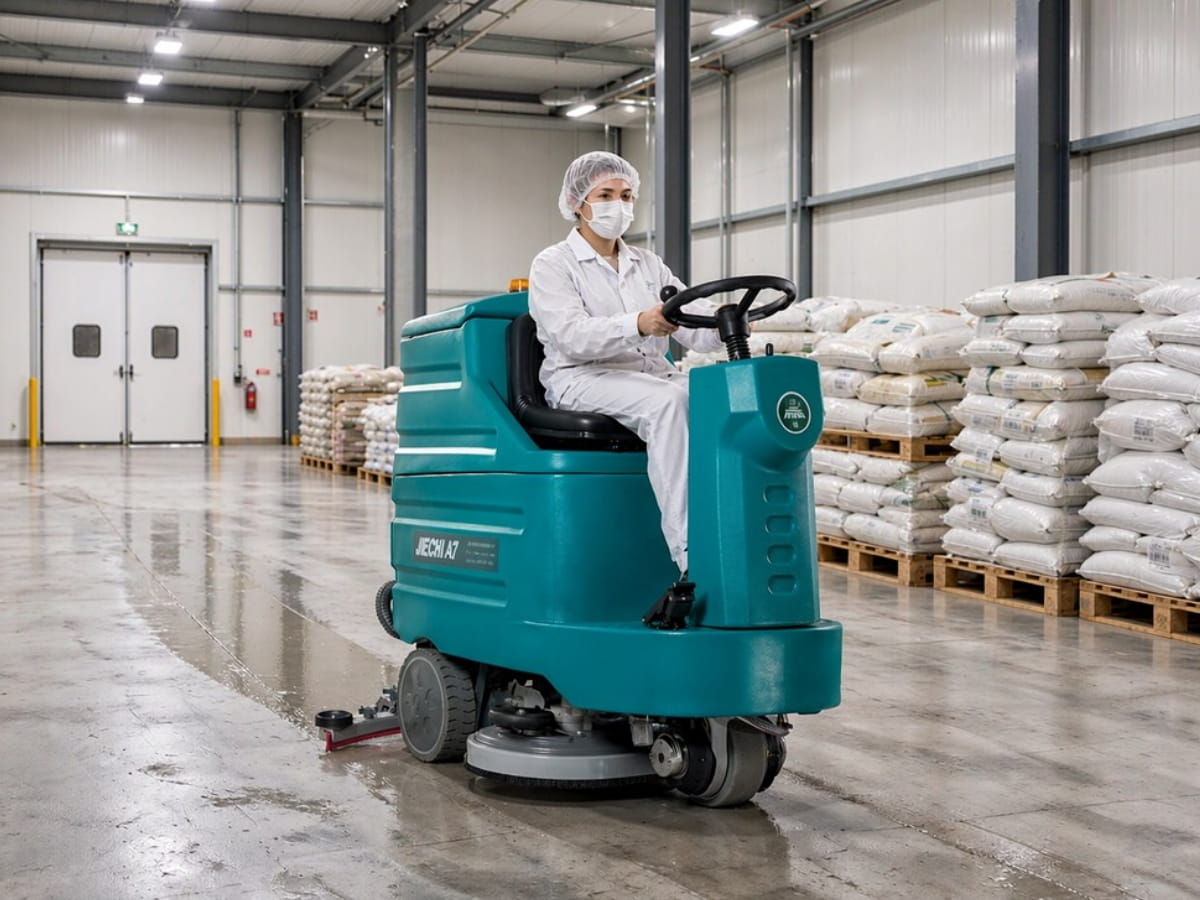
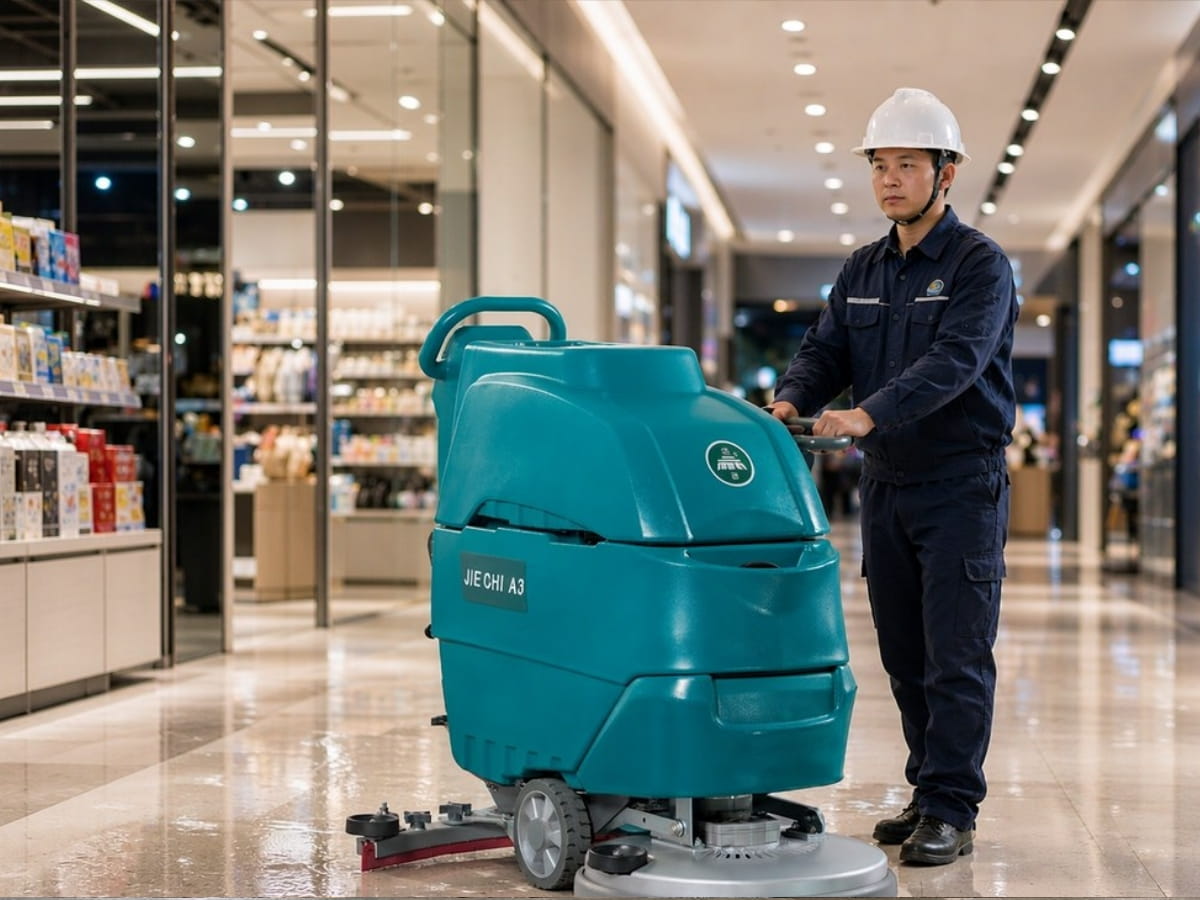
    A supermarket floor is never dirty in one uniform way. Before the first shopper arrives, the entrance mats have already collected a night of grit, the produce misters have left a damp arc around the display, and the chilled cabinets have been dripping condensation onto the tile since the doors began cycling. By midday the checkout lanes carry a polish of shoe traffic and at least one spilled drink. None of that waits for closing time, and none of it is answered by shutting the store and mopping the whole floor once. That is the real problem behind supermarket floor cleaning: the work happens with shoppers a metre away, and the surface has to be safe to walk on the moment the cone comes up. Below: the zone rhythm that makes short passes possible, where a slip film actually comes from, how aisle geometry decides between a compact ride-on and a walk-behind, and a pre-opening and midday pass you can hand to a shift leader as a written sequence. Quick Answer Cleaning a supermarket floor while the store trades means working one zone at a time, not one floor at a time. Close a single aisle with cones, run a low-solution scrub pass with immediate vacuum recovery, then check the surface at a grazing angle before you reopen it. The machine has to fit the clear width between gondola ends and the gap beside the checkout belt, and its squeegee blades must be sound so no detergent residue is left behind. Chilled cabinet door seals, produce misters and entrance matting keep re-wetting the tile, so they belong on a separate spot-check loop rather than in the main pass. A 530 mm scrub deck is the usual fit for retail aisles; larger industrial decks belong in the backroom or after closing. The deciding measure is not how fast the machine cleans — it is how quickly a cleaned strip can be handed back to shoppers. Key Takeaways Trade-hour work is zone work: one aisle closed, cleaned, verified and reopened before the next — never a whole-floor wet pass. A slip film is usually a process fault, not a machine fault: excess solution, worn or badly angled squeegee blades, or a pass made too fast for the recovery system. Measure the narrowest clear width between gondola ends and the gap between the checkout belt and the queue barrier; size the machine to that number plus a turning allowance, not to a brochure coverage figure. A3 (50 / 55 L, 2,200 m²/h, 155 kg) and A5 (65 / 75 L, 2,700 m²/h, 220 kg) both use a 530 mm scrub deck; the choice is tank endurance, mass and operator posture, not cleaning width. Chilled cabinet seals, produce misters and mat wells are recurring wet sources — fix the source before you scrub the symptom. Rated coverage is a theoretical number. Time one full aisle including turns and build your pass window from the achieved rate. Table of Contents Why supermarket floors need a different cleaning rhythm Aisle width Where a compact ride-on fits and where a walk-behind wins Why supermarket floors need a different cleaning rhythm A warehouse floor is cleaned against one clock: how long until the shift starts. A supermarket floor is cleaned against two. The store clock says the aisle must be trading again; the drying clock says the tile is not ready yet. Every decision about supermarket floor cleaning sits between those two clocks, which is why a method borrowed from a distribution centre fails on a grocery shop floor even when the machine is the same. The first change is the unit of work. In a warehouse the unit is the floor; in a supermarket it is the strip. You close one run between two gondolas, clean it, verify it, take the cones away, and only then move to the next. Shoppers detour around one closed aisle without noticing; they cannot detour around a wet perimeter that encircles the store. That single change also removes the most common complaint about cleaning between trading hours — that the cleaning team is always in the way — because at any moment only a short section is out of use. The second change is the order. Dirt arrives in a supermarket in a predictable sequence: grit at the entrance, moisture and leaf litter at produce, condensate along the chilled run, shoe polish at the tills, crumbs wherever samples are handed out. A written route puts those zones in a fixed order so the operator is not deciding under pressure which one to hit next, and so the wet sources are dealt with before they can spread down an aisle on a trolley wheel. If you are building this from scratch, a retail and supermarket floor cleaning programme gives you the zone vocabulary; your own store plan gives you the distances and the timing. The third change is visibility. A retail floor cleaning machine works within arm's reach of a queue: cones go at both ends of the strip, the operator must be able to stop instantly, and no hose crosses the open side. On a ride-on, the seated position and low front deck make a crowded aisle harder to read. One aisle closed, the rest of the store trading: the cone marks the boundary of the strip, not the boundary of the cleaning shift. None of this is about working faster. It is about making the wet window short, local and verifiable — which turns machine selection into a question of fit and the drying question into a checklist. Aisle width Supermarket floors are a set of obstacles, not an open plane. Before choosing a supermarket floor scrubber, walk the store with a tape measure and record three numbers: the narrowest clear width between two gondola ends, the gap between the checkout belt and the queue barrier, and the clear turning space at the end of the longest straight run. Compare them with the machine's overall body width plus a turning allowance. Rated coverage in m²/h is calculated from deck width and travel speed on an empty floor; it says nothing about whether the machine can get around a promotional pallet without clipping it. Wet scrubbing without leaving a slip film A slip film is the residue left after the machine has passed. The floor can look dry and still be slick — which is why a pass can be technically finished and operationally unusable. It comes from five places: too much detergent, a dose unmatched to water hardness, squeegee blades that are worn or set at the wrong angle, a speed that outruns the vacuum, or a second wet pass over a strip already drying. Work through them in that order: the first three are settings, the last two are behaviour. Dose to the detergent label at the lowest effective concentration and log the batch — more product leaves more to be recovered. Check the blades at the start of every pass for nicks and even contact, replace them as a set, and set travel speed by what the vacuum can pick up, not by the shift schedule. Solids and free liquid are collected before the machine arrives; a scrub deck should never be the first tool on a spill like this. For slip-resistant floor scrubbing during trading hours, the most useful habit is the dry recovery pass: shut off solution flow and run the same strip again with the squeegee and vacuum only. It removes the residue a single pass leaves at turns, where speed drops and dosing continues. Make it standard on cold tile — and never re-dose a strip that is already drying. Verification must be repeatable, not a judgement call. Before the cones come up: look along the strip from a low grazing angle for a continuous sheen, press a clean white cloth to the tile and check for moisture transfer, then walk the strip the way shoppers will. If any check fails, run the dry recovery pass again. A cone is a statement about the floor, not the machine. Where a compact ride-on fits and where a walk-behind wins The two machines most often compared for a grocery floor are deliberately similar at the business end. A3 and A5 both carry a 530 mm scrub deck, both run a 24 V / 100 Ah pack, and both are short enough to work a gondola run. What separates them is tank endurance, mass and how the operator sits or stands — which is exactly what a trading-hours routine is sensitive to. Specification A3 walk-behind A5 compact ride-on Scrub width 530 mm 530 mm Suction width 770 mm per datasheet Solution / recovery tanks 50 / 55 L 65 / 75 L Rated coverage 2,200 m²/h 2,700 m²/h Machine weight 155 kg 220 kg Dimensions (L × W × H) 127 × 55 × 109 cm 126 × 62 × 103 cm Same 530 mm deck, different operating posture: the choice is about tank stops, visibility and turning room, not scrubbing width. A compact ride-on earns its place on long, straight, repeatable work: the perimeter run, the backroom, wide ambient aisles after opening, and any route an operator would otherwise walk several times a shift. Larger tanks mean fewer refill stops across a sequence of strips, and seated operation reduces fatigue when the same route is run daily. For that duty, a 65 L compact ride-on floor scrubber is the practical size — big enough to finish a zone on one fill, still narrow enough to be turned at a gondola end. A walk-behind wins wherever the work is short, crowded or unpredictable: checkout lanes, end displays, spot response to a spill, and any aisle where the operator needs to step aside for a shopper mid-pass. The operator is standing at handle height, can see over the deck, can stop and reverse instantly, and can lift the squeegee to leave a strip open. Where the store plan has many of these micro-zones, a 530 mm walk-behind floor scrubber covers them without the mass and sightline penalty of a seated machine. Most stores end up with both, assigned by zone rather than by shift: the ride-on on the long routes, the walk-behind on the interruptible ones. Both packs are 24 V / 100 Ah, so the charging window belongs in the plan too — a machine that is on charge at the start of the midday pass is a scheduling failure, not a battery problem. Common Questions Can you scrub a supermarket floor while shoppers are in the store? Yes, if the work is zoned: cone one strip, scrub with immediate vacuum recovery, verify, then reopen before moving on. You cannot wet the whole sales floor at once — there is no way to keep shoppers off it or verify all of it before someone walks on it. What causes the slippery film after machine scrubbing? Usually detergent residue, not water: an over-strong dose, nicked or mis-angled blades, a pass too fast for the vacuum, or a second wet pass over drying tile. Fix the dose and blades first, then slow the pass and add a solution-off recovery run. How do you know an aisle is dry enough to reopen? Use three checks: look along the strip from a grazing angle for sheen, press a clean white cloth to the tile for moisture transfer, then walk it the way shoppers will. If any fails, run the squeegee and vacuum again with solution off. Cones stay until all three pass. Which machine suits narrow grocery aisles, ride-on or walk-behind? Measure the narrowest clear width between gondola ends against machine width plus a turning allowance. On long straight runs a compact ride-on saves fatigue and refill stops; on short, crowded or interrupted runs a walk-behind gives better sightlines and an instant stop. Both A3 and A5 use a 530 mm deck, so geometry rarely decides it alone. Conclusion Supermarket floor cleaning during trading hours is a zoning problem before it is a machine problem. Work one strip at a time, deal with the wet sources before the tile, keep the dose low and the blades sound, and verify the surface before the cone comes up. The machine choice follows from the store plan: a 530 mm deck for the aisles, a compact ride-on for the long repeatable routes, a walk-behind for the interruptible ones. Time one aisle on your own floor, write the two passes down, and the slip film stops being a recurring complaint. Want the zone plan checked against your store layout? Send us your aisle widths, your chilled run and your trading hours — we will map the two passes onto your floor plan and suggest which zones belong on a ride-on and which on a walk-behind, even if you are not buying from us. Email: kliu@jiechi.com  |  Phone / WhatsApp: +1 240 314 9021 Contact us
  • Escalator Cleaner Buying Guide: What an EL510 Escalator Cleaning Machine Can and Cannot Do
    Nov 04, 2026
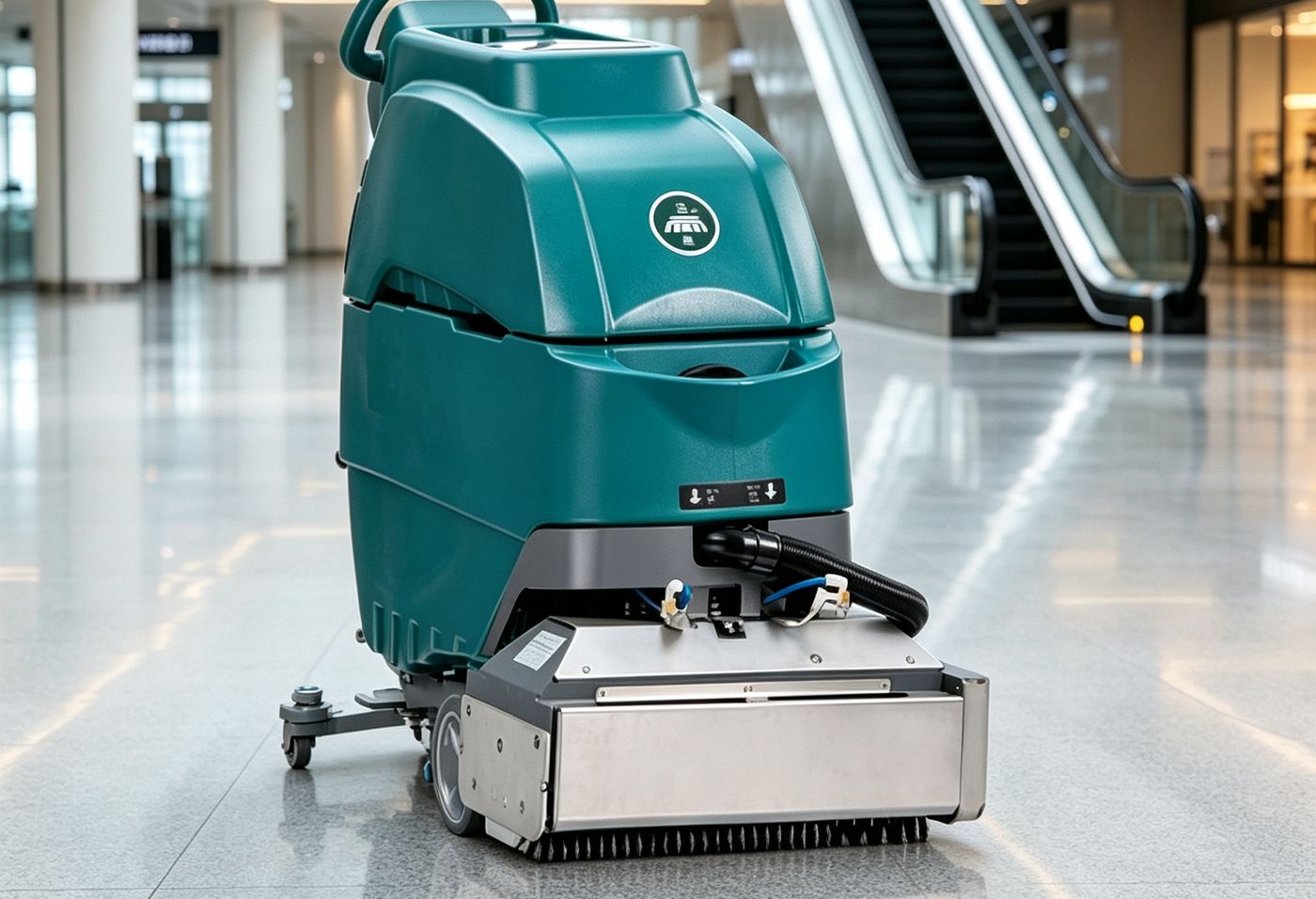
    Escalator steps punish a cleaning budget quietly. The grooved treads pack solid with grit and the black ring that builds at every landing, and the only tool that reaches those grooves properly is a hand brush worked step by step. Escalator cleaners exist to end that routine, but they are easy to buy wrong: buyers who treat them as small floor scrubbers get surprised by what the brush never touches. Below: what a step-cleaning machine actually cleans, the three machine classes, what a 510 mm / 770 mm machine handles, where it stops working, how to build a steps-per-hour figure, and the checklist to run before you sign. Quick Answer An escalator cleaner mounts the running escalator, locks onto a step and travels with it, scrubbing tread and riser with a purpose-built brush — wet or dry — and vacuuming the slurry into its own tank. The escalator keeps running the whole time: no shutdown, no lost service. A current EL510-class machine runs a 510 mm main brush behind a 770 mm suction width, a 900 W brush motor at 435 rpm, a 2,400 W vacuum and an 800 W traction motor, with 50 L of solution and 55 L of recovery on a 140 kg frame — water feed, scrubbing and suction-drying combined in a single pass, and an automatic guidance system that fits every escalator type. It cleans steps and nothing else: handrail, glass, comb plates and the structure below need separate methods. Key Takeaways Judge it as a step machine, not a small floor scrubber: an automatic guidance system fits it to every escalator type, it locks onto the step and rides the running escalator — no shutdown needed, the escalator stays in service. The datasheet numbers that matter: 510 mm main brush, 770 mm suction width, 900 W brush motor at 435 rpm, 2,400 W vacuum, 50 L / 55 L tanks, 140 kg, 125 × 59 × 109 cm. Water feed, scrubbing and suction-drying run in one pass: wet mode is the periodic deep clean, dry mode is the faster maintenance pass. Four things it never cleans: handrail, balustrade glass, comb plates, truss — scope them separately. Put the confirmed figures in the tender in writing — 900 W brush motor, 435 rpm, 2,400 W vacuum, 50 / 55 L tanks — so the delivered machine matches the spec you ordered. Throughput is a formula you fill in at a demonstration, not a brochure promise: steps per hour = 3,600 ÷ seconds per step cycle. Table of Contents What an escalator cleaner actually cleans Machine classes: handheld, walk-behind and ride-on What an EL510-class machine handles Where escalator cleaners stop working What an escalator cleaner actually cleans Start with the surface, because everything about this class follows from it. An escalator step is not a floor: the tread is a comb of narrow metal cleats with a groove between each pair, the riser is a matching vertical face, and soil packs into those grooves under thousands of shoe soles a day. Mops ride over the top, and a brush shaped for flat slabs skips the profile entirely. A dedicated escalator cleaner carries a brush built for that profile: it locks positively onto the step — datasheets call it secure step engagement — digs into tread and riser grooves in one stroke, and recovers the slurry so the step can reopen dry. The working surface: narrow cleats, deep grooves and a comb plate at the landing — geometry no flat-floor machine was shaped for. The class runs two modes, and both belong in your routine. Wet mode resets a neglected escalator; dry mode skips the solution and clears the daily film faster. Both leave the same result: an empty groove instead of a black one. And notice what the description never claims — handrail, glass, comb plates and the structure under the steps sit outside the brush's reach. Machine classes: handheld and walk-behind You will meet three classes, and they are not interchangeable. Handheld step tools — brushes, grooved rollers, scrapers — are worked by an operator on foot. They cost little and they do reach the groove, but the result depends entirely on the person, the pace is slow, and the slurry ends up on the landing floor instead of in a tank. They suit one flight or a touch-up; they do not scale to a shopping centre. Walk-behind indexed machines are the class this guide covers, typified by a compact wet/dry escalator cleaning machine. The operator walks beside it while the machine locks onto a step and travels with the moving escalator — cleaning happens in service, with no shutdown — turning escalator cleaning from a craft into a scheduled, repeatable shift task. What an EL510-class machine handles Here is the datasheet for the current class benchmark, read the way a buyer should read it — widths and power first. Specification EL510-class datasheet figure Main brush width 510 mm Suction width 770 mm Brush motor 900 W Brush rotation speed 435 rpm Vacuum motor 2,400 W Traction motor 800 W Solution / recovery tanks 50 L / 55 L Machine size (L × W × H) 125 × 59 × 109 cm Machine weight 140 kg Power supply Mains, 220 V (confirm the delivered variant in writing) The class benchmark: a 510 mm brush deck under a recovery hood, 140 kg, sized to sit on a single escalator step. Read the widths first. The 510 mm brush sits within the width of a standard commercial escalator step, so the tread face is covered without the frame fouling the skirting; wider steps take more than one pass, which your demonstration will show. The 770 mm suction width runs wider than the brush on purpose — it catches the mist the brush throws toward the skirting, keeping the glass and cladding clean while you work. Then the power split. A 900 W brush motor turning at 435 rpm does the mechanical work in the grooves, with the water feed wetting the surface ahead of it and the 2,400 W vacuum pulling the slurry out behind — supply, scrub and suction-dry in a single pass. The vacuum is the larger number, and deliberately so: recovering slurry from a grooved surface is harder than laying water on a flat one. The 800 W traction motor drives the machine along the flight under control, and the automatic guidance system keeps it engaged with the steps as it adapts to each escalator type. One design feature deserves a paragraph of its own: the automatic guidance system. It is the reason a single machine covers every escalator on your site — the guidance keeps the brush deck aligned with the step profile across all escalator types, so you are buying one tool for the whole estate rather than per-escalator tooling. Portability belongs in the same sentence: measure your lift car, the door widths and the tightest turn on the route before you order. Where escalator cleaners stop working The honest map of what a step machine covers is narrower than the escalator itself — draw the boundary before the quote, not after the delivery. Green faces — treads and risers — are what a step machine cleans. The machine starts on the bottom step and rides the running escalator upward; the handrail, the glass, the comb plates and the structure below sit outside the brush. The handrail comes first. It is a moving rubber loop, not a step, and it carries a film of skin oils that passengers notice faster than anything on the treads. Dedicated handrail machines and wipes exist for that surface; the step machine does not touch it. The balustrade glass and cladding are a spray-and-squeegee job. The comb plates at both landings sit right where the machine starts and finishes, but the teeth and their recess are hand-detailing work with a small brush — the machine's brush deck does not fit them. The truss and pit below are a specialist contractor's territory. The surrounding floors belong to floor machines, as the class section argued. And when a washdown leaves standing water on the landing, a slurry and flood pick-up wet vacuum keeps the area safe while the step machine works.  Common Questions Does the escalator have to be shut down for cleaning? No. The machine mounts the running escalator and travels with the steps, so cleaning fits inside opening hours — no shutdown and no lost service time. Barrier the landing where the machine starts and finishes so passengers keep clear of it. Will it clean the handrail? It will not — the handrail has its own equipment class, from dedicated handrail cleaning machines down to impregnated wipes for short loops. Put it in the same tender so both methods are scheduled together. Wet or dry mode — when do I use each? Wet mode resets packed grooves; dry mode maintains the result between deep cleans. The split is yours to set from traffic. Will it fit through my building's lifts and corridors? At 125 × 59 × 109 cm and 140 kg, most service lifts carry it — but paper dimensions have embarrassed better buyers than you. Walk the transport route with a tape measure first. How often should escalator steps get a machine clean? Traffic decides, not the calendar: a transit hub and a quiet office lobby will not share an answer. Set the first interval from appearance, then adjust from what the deep clean actually recovers. Conclusion An escalator cleaner is a step machine, full stop. The EL510-class numbers — a 510 mm brush, 770 mm of suction, 900 W of brush power at 435 rpm and a 2,400 W vacuum on a 140 kg frame — are built to reset treads and risers that hand tools reset slowly and floor machines reset never. An automatic guidance system fits it to every escalator type, water feed, scrubbing and suction-drying run in a single pass, and the escalator stays in service throughout. Its boundary is just as clear: handrail, glass, comb plates, truss and surrounding floors are other purchases. Scope the whole escalator, time a cycle at a demonstration, and let the formula set your steps per hour. Want a throughput figure for your own escalators? Send us your step count, flights and traffic pattern — we will return a written cleaning-window estimate and the right machine class, even if it is not ours. Email: kliu@jiechi.com  |  Phone / WhatsApp: +1 240 314 9021 Contact us
  • A7 vs M20 : Same Footprint, Scrubber or Sweeper-Scrubber?
    Nov 03, 2026
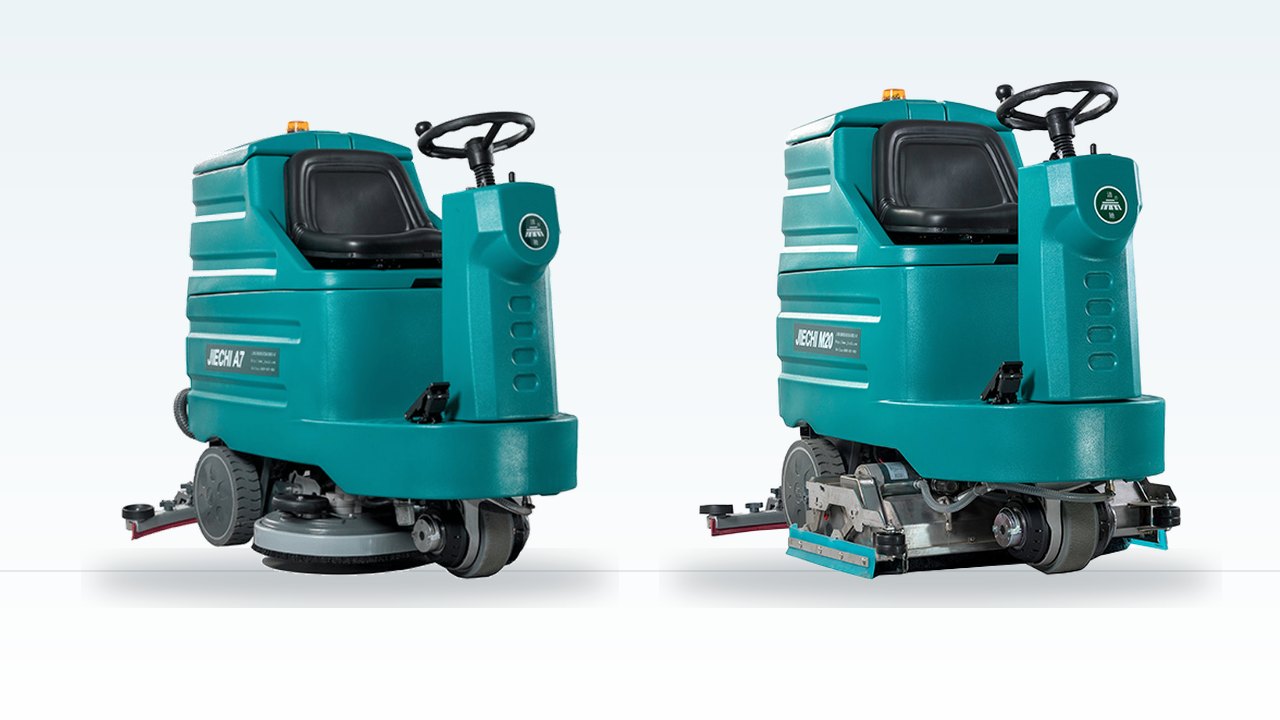
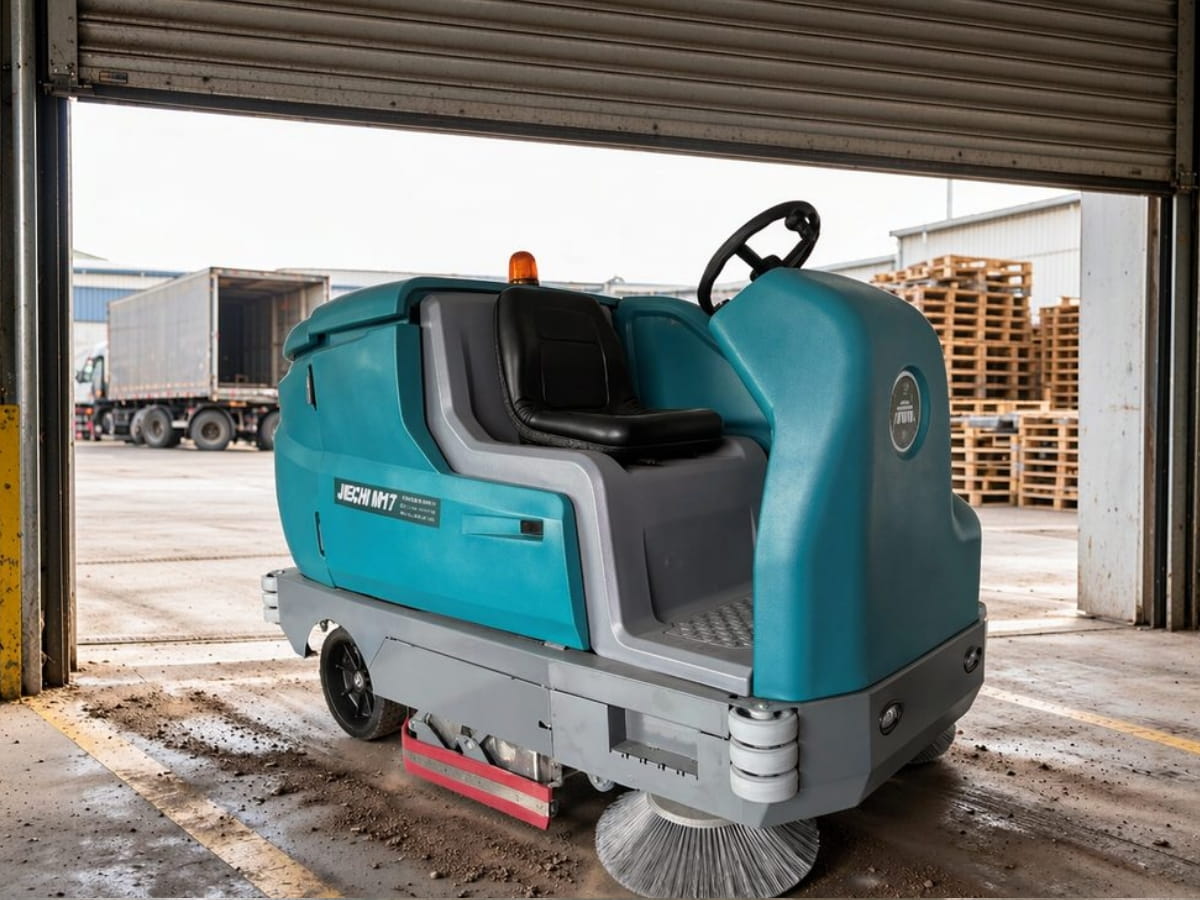
    Most buyers compare the Jiechi A7 and the M20 the same way they compare anything else: price on one side, cleaning width on the other. Both numbers mislead you here. The A7 — a dual-brush ride-on floor scrubber — is not the cheap option, and the sweeper-scrubber combination machine is not the wide one. They are the same machine with one component added, and that component decides whether your floor gets worked once or twice. Below: the three real spec differences, what the hopper picks up and jams on, how throughput changes with debris on the floor, and a ten-minute test you can run tonight. Quick Answer The A7 and the M20 share the same chassis, battery, brush motors and 5,500 m²/h rating, so either one fits the same site survey. The only real choice is whether you need the M20's 20 L front hopper. If dry, loose debris lands on your floor every shift — cardboard dust, stretch wrap, grit, wood chips — the M20 sweeps it up before scrubbing and removes an entire pass from your routine. If your floor stays dry-clean or is wet by nature, buy the A7 and keep 10 L more water capacity. Key Takeaways Identical 165 × 90 × 130 cm chassis, 330 kg, 24 V / 200 Ah battery, 560 W × 2 motors, 5,500 m²/h rated — every site constraint (doors, lifts, ramps, charging bay) applies equally to both. Three real differences: the M20's deck is 40 mm wider, its tanks hold 10 L less each, and it carries the 20 L debris hopper. The hopper's value is pass removal, not width: on a debris floor the A7 needs a sweep pass and a scrub pass, while the M20 finishes in one. On normal warehousing debris the bin is emptied far less often than the tank is refilled — the hopper rarely becomes the machine's limiting cycle. The hopper cannot be retrofitted onto an A7 later, so decide before you buy, not after the first season of complaints. Table of Contents One chassis, 165 × 90 × 130 cm, 330 kg: what actually differs The 20 L debris hopper and what it really picks up Throughput on a clean floor vs a debris floor Water and hopper stops: two cycles instead of one Which floor type makes the decision for you One chassis, 165 × 90 × 130 cm, 330 kg: what actually differs Here are the numbers from both datasheets, side by side. Read the last five rows first — they are identical, and that is the point. Specification A7 — scrubber M20 — sweeper-scrubber Brush deck width 860 mm 900 mm Solution / recovery tanks 140 L / 150 L 130 L / 140 L Debris hopper — 20 L Rated coverage 5,500 m²/h 5,500 m²/h Battery 24 V / 200 Ah 24 V / 200 Ah Brush motors 560 W × 2 560 W × 2 Machine weight 330 kg 330 kg L × W × H 165 × 90 × 130 cm 165 × 90 × 130 cm Same chassis, same battery, same rated output. The M20 adds a sweeping roller and a 20 L bin ahead of the brush deck. Three differences, no more: a brush deck 40 mm wider, tanks 10 L smaller, and a 20 L hopper. Everything the site survey hinges on — doors, lifts, ramps, charging bay, mezzanine load limit — is unchanged, and a 90 cm doorway rules out both in exactly the same way. The parts picture is almost as tight: brushes, pads and squeegee blades sit in the same deck family, so a storeroom stocking for one largely covers the other. The hopper assembly — roller, bin, filter — is the only stock the M20 adds. That matters at negotiation time too: the supplier's cost difference is one component, not a machine class, so ask for itemised quotes. The 20 L debris hopper and what it really picks up The hopper sits ahead of the brush deck. A roller lifts loose material into a 20 L bin, and only then does the deck lay down solution and scrub. That order matters more than the capacity number, because it means debris leaves the floor dry, as debris, instead of being wetted, crushed and smeared into a slurry your squeegee then has to chase. The hopper's home turf: dry, loose material that a sweeping roller can lift before the deck ever touches it. What goes in and what does not is the honest part of the decision, so here it is without marketing: Debris on your floor 20 L hopper Note Cardboard dust, paper, cores Picks up The main warehouse case Stretch film, pallet wrap Picks up Light film can tangle; clear it before it balls up Wood splinters, pallet chips Picks up Up to roughly 30 mm Entrance grit, small gravel Picks up The reason retail floors stay scratch-free Wet leaves, mud, caked soil Partial Sticks to the bin; needs a manual clear Standing water, oil, slurry No That is the deck's job, and both models do it String, cable, twine, wire No Wraps the roller — the one real operating risk Fine sand under 1 mm Partial Needs a slower pass, do not run at full speed Read that table against your own floor and the decision usually becomes obvious. Dry and loose most of the time, and the hopper works every shift; wet by nature — a washdown area, a bottling line — and it sits empty. In textile, packaging and cable operations the roller will pick up strapping within minutes — that is what a sweeping roller does, not a defect. Plan a two-minute check at every water stop. Throughput on a clean floor vs a debris floor Both machines are rated at 5,500 m²/h. On a clean, sealed floor that rating is the whole story: same speed, same deck class, same result — and paying extra for sweeping capacity you never use buys nothing. On a debris floor the rating stops meaning the same thing, because the A7 now needs two passes. Either a second operator takes a walk-behind sweeper ahead of it, or the scrubber pushes debris into a wet strip the squeegee drags along. Whichever way you arrange it, the work happens twice. One visit or two: the debris that forces the A7 into a second pass is gone before the M20's deck touches the floor. Across a shift, the debris row is the only one that matters: the M20 finishes in one pass what the A7 finishes in two. Even when a walk-behind sweeper handles the pre-sweep, its pace is slower than a ride-on's, so the gap narrows but never closes. Debris problems are rarely solved by buying a wider scrubber — a 1,060 mm deck still needs the debris gone first. Width buys speed on clean floors; only the hopper removes the pass. Water and hopper stops: two cycles instead of one Now the cost side, and it is smaller than the throughput gain. Because the hopper occupies volume inside the same envelope, the M20 carries 10 L less solution and recovery water — slightly shorter runs between refills, usually the only operating penalty of the combination. In practice, on normal warehousing debris the bin is emptied far less often than the tank is refilled, so the M20 does not add a stop to your shift — you empty the bin while you refill the tank, one stop doing two jobs. On a genuinely filthy floor the rhythm can flip. That is not a reason to reject the machine — just check the bin rhythm in week one, not month three. Which floor type makes the decision for you Most buyers do not choose on economics — they choose on what is on the floor at 7 a.m. Match your situation to the row below and the answer is usually settled before the quote arrives. Your floor Buy Why Sealed concrete warehouse, cardboard dust, wrap M20 The debris is the whole problem, not the floor Food plant, washdown area, wet slurry only A7 Nothing dry to pick up; keep the 140 L Supermarket or mall, entrance grit and paper M20 Grit at the doors scratches the finish Showroom, polished floor, dust only A7 A dust mop handles the dry work for less Mixed multi-tenant industrial park M20 You cannot control what tenants drop Textile, packaging, cable operations A7 plus manual sweep String wraps any sweeping roller Cold store below −10 °C Neither Battery and ice behaviour differ — spec separately If you are still undecided, run a ten-minute test that settles it better than any brochure. Mark three 2 × 2 m squares — one at your busiest doorway, one mid-aisle, one where your worst mess happens. Sweep each into a dustpan and look at what you collect. Dry and loose in two of three, and the hopper earns its premium; sticky, wet or greasy in two of three, and the A7 is the better machine for the money. Whichever way the test goes, specify both machines the same way: brush type matched to your floor finish, squeegee blade material matched to your chemistry, spares quoted with the machine rather than after the first failure. Those details move lifetime cost more than the model choice. If your aisles are tighter than a ride-on allows, the walk-behind M16 combination machine does the same sweep-then-scrub job in a smaller footprint — the same logic, half the turning circle. Common Questions How much more does the M20 cost than the A7? The M20 adds a sweeping roller, a 20 L bin and a filter to an identical chassis, so the price gap should reflect that hardware, not a different machine class. Ask for both quotes itemised so the hopper appears as its own line — a premium with no breakdown deserves an explanation before you sign. Can I add a sweeping hopper to an A7 later? No. The hopper is built into the chassis ahead of the deck, with its own drive and bin, so it is not a bolt-on accessory. If debris is likely to become a problem within two years, decide now rather than buying twice. Will a 20 L hopper keep up with a large warehouse? On normal warehousing debris, yes: the bin fills far less often than the tank empties, so it is rarely the limiting cycle. On heavily loaded floors it fills faster — check it at every refill during week one. Does the M20 clean a wet floor as well as the A7? Yes. Both run twin 560 W brush motors on the same deck family, with a 900 mm deck on the M20 against 860 mm on the A7. The only wet-side difference is 10 L less solution and recovery capacity, which shortens the refill cycle slightly. Why does the M20 carry 10 L less water? The hopper and its bin occupy volume inside the same 165 × 90 × 130 cm envelope, and nothing was added to compensate, so the tanks gave up 10 L each — a deliberate trade for a shorter water cycle. Can one machine cover both a warehouse and the office area? It can, if office flooring is hard and sealed — though it will not replace a carpet extractor, and the hopper is unnecessary there. If offices make up more than a third of the total area, a smaller walk-behind alongside often costs less to run than forcing one machine to do both. Conclusion The A7 and the M20 are one machine and one component. Judge them on a single question: is there dry, loose debris on your floor every day? If yes, the 20 L hopper removes an entire pass and roughly doubles the floor you finish per shift on debris days. Ten litres of water is a fair price for that. If no, buy the A7 and keep the larger tank. The most common mistake here is not buying the wrong machine — it is paying for sweeping capacity that never gets used. Not sure which one fits your floor? Send us three photos of your floor and your daily cleaned area — we will reply with a written recommendation, even if the answer is neither machine. Email: kliu@jiechi.com  |  Phone / WhatsApp: +1 240 314 9021 Contact us

  • How to Keep Printing and Packaging Factory Floors Clean: A Practical Cleaning Guide
    Oct 30, 2026
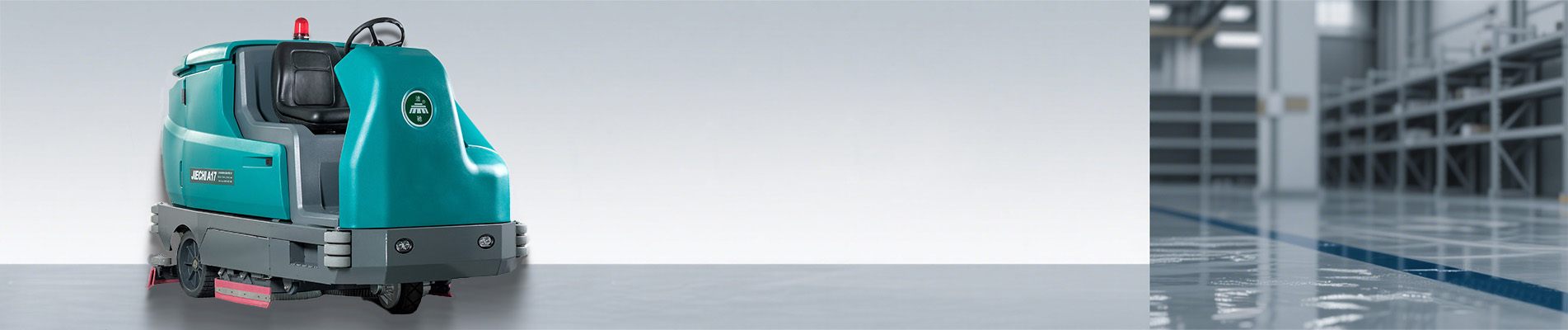
      A printing plant does not have one floor problem. It has four or five, sitting within shouting distance, and the operator who runs a single scrubber across all of them ends up with a film on the floor and a complaint list from production.     Machine split: press hall, corrugator, converting   The three areas want different machines. The reason is aisle geometry, not soil.   Press hall. Rolls, trolleys and press units sit close together, so what matters is footprint and turning. A mid-size ride-on at 860 mm scrub width and a 1,100 mm suction width fits the gaps and still covers the open run along the presses. Our A7 ride-on scrubber is rated at 5,500 m²/h with 140 L clean and 150 L recovery, which is roughly three press bays on one tank. It turns on the spot, which is what you need at the end of a press line.   Corrugator and paper store. Open floor and heavy dust. Run lengths are long and the floor is clear, so a larger machine earns its place here.   Converting and despatch. Pallet stacks change every shift. A large machine waits to pass; it only pays off in the open despatch lane.   Area Scrub width Rate Tanks Press hall (A7) 860 mm / 1,100 mm suction 5,500 m²/h 140 L / 150 L Despatch, paper store (A17) 1,060 mm / 1,400 mm suction 8,600 m²/h 300 L / 350 L   The A17 runs a 36V/460Ah pack and is quoted at 7–8 hours on one charge. That is a full shift with the charging done overnight, not a mid-shift swap. At 1,525 kg it also wants a floor slab you have checked, not assumed.   Step-by-step daily cleaning routine   Sequence matters more than effort.   1. Dry through first. Run a dry sweep from the cleanest end toward the press hall. Paper dust goes in the bin, not the recovery tank. On a corrugator line this step can run the length of the line and back.   2. Spot-treat at the source. Ink at the press feet, adhesive at the gluer. Scrape the bulk, apply degreaser, give it the dwell time on the label, then scrub. Ten minutes here saves a full-hall scrub.   3. Scrub clean end to dirty end. Aisles last, not first, or you drag press-hall water back through the clean zone.   4. Watch the recovery water. When it turns grey-black, stop and dump before the next aisle. A full tank does not suction, and a machine that is not suctioning is just spreading.   5. Squeegee check before the last pass. One nick in the rubber leaves a line across a whole aisle, and it will still be there in the morning.     Slip risk, dust and worker safety   Two safety issues come straight from the floor here: slip on damp sealed concrete, and dust in the air during dry sweeping.   Sealed concrete becomes genuinely slippery when damp. That is why the scrubber should leave the floor as dry as it can, and why the squeegee and suction motor deserve more attention than the brush. A pass that looks clean but leaves a sheen is a hazard.   Dry sweeping a corrugator line lifts paper dust into the air, where it settles on wet ink and machine guards. A damp pass or a scrub-sweep with a hopper does the job without the cloud.   FAQ Can a floor scrubber remove dried ink from a press hall floor? Fresh mist, yes, with a degreaser and short dwell. Ink bonded into a sealer needs mechanical action first. Brush pressure alone will not do it. Why does the floor look worse after scrubbing? Usually dirty recovery water or a worn squeegee. Both leave a film that dries as haze. Dump the tank when it turns grey and check the squeegee edge before the final pass. What size scrubber fits a press hall? Around 860 mm scrub width with a 1,100 mm suction path, on a machine that can turn on the spot. Measure the narrowest gap between a press and the nearest roll or trolley before you shortlist anything. Printing plant floor cleaning is three jobs in one building. Sweep dry before anything gets wet, treat ink and adhesive at the source, and size the machine to the aisle rather than the square metres. A7 for the press hall, A17 for the open despatch floor, and a Sunday shutdown for everything the daily pass cannot reach. That combination keeps the floor dry, the squeegee honest and the incident log short. Size a machine for your plant Send us your floor plan, aisle widths and the soils you fight most. We will come back with the scrub width that fits . Tel: +1 2403149021  |  Email: kliu@jiechi.com
  • How to Deploy Cleaning Robots Safely in High-Traffic Public Spaces: Retail and Airports
    Oct 28, 2026
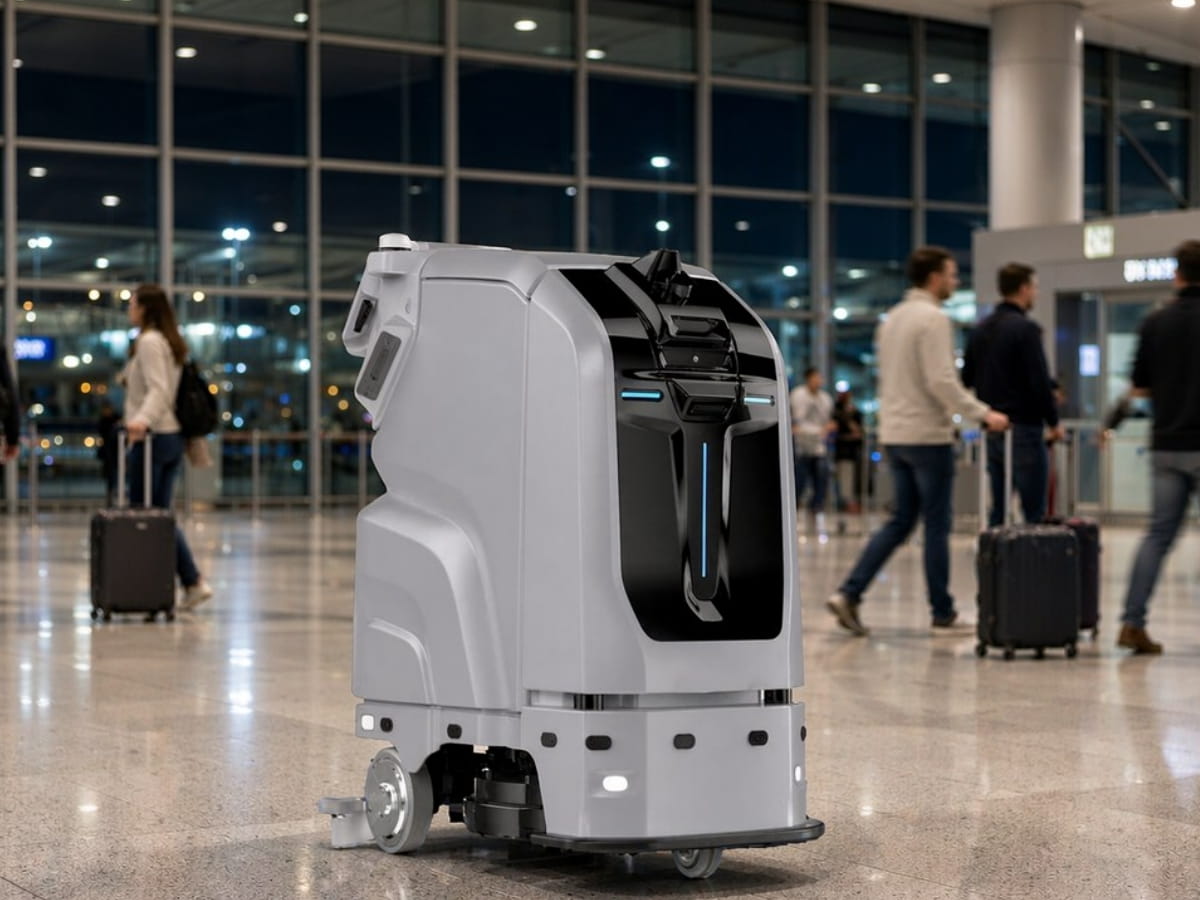
        Quick Answer Cleaning robots in retail and airports work when three things are true at once: the area is mapped with its fixed obstacles marked, the route avoids peak footfall, and the dock handles charging plus water on its own.    Robotic cleaning public spaces is mostly a question of predictability. Warehouse layouts change weekly. A shopping concourse or a departure hall does not, and that is why these two building types sit at the front of every deployment list.   Cleaning robots in retail and airports are not a technology problem. They are a mapping problem, a route problem and a dock problem, in that order. Annotate the map, split routes by footfall, put the dock where the run ends, and report coverage plus interventions. Get those four right and the machine just becomes the thing that cleans the concourse.   Why retail and transport hubs deploy first   Three conditions decide whether an autonomous machine pays for itself, and malls and terminals satisfy all three. The floor is large and open. The layout holds still for months. The task is identical every night: cover everything, leave it dry, finish before doors open.   Night shifts in public buildings are expensive and hard to staff, and the work is dull enough that turnover stays high. A machine that takes the open concourse leaves people on the jobs that need judgement.   Our JC80 autonomous scrubber is rated at 2,040 m² per hour, at 1.2 m/s with a 510 mm scrub path. Treat that as an upper bound. Real coverage depends on how much of the plan is open floor.     Working among shoppers and passengers safely   Cleaning robots retail airport deployments differ from warehouse ones in one respect: the public is in the same space and is not paying attention. People stop without warning, push trolleys into the path and walk backwards while looking at a phone.   The JC80 carries a fused sensor set for that. A panoramic monocular camera, LiDAR, a 3D ToF module, a single-line laser, an IMU, ultrasonic radar and a physical bumper strip. Reaction is quoted at 20 ms, with 2 cm recognition accuracy and a 210° forward field of view. It runs under 65 dB, which is why it can work a trading floor at all.     Sensors reduce risk but not remove it. Speed matters as much as sensing. A machine at 1.2 m/s through a lunchtime food court is a different proposition from the same machine in an empty hall at 05:00. Route design for peak and off-peak   Map first, then edit. Raw mapping only draws the boundary; the useful work is the annotation layer on top. On the JC80 that means laser-shielded zones, floor material per area, boxed lift zones, speed bumps, and the road network the machine may use.   Then split the day. Autonomous scrubber mall projects that fail usually fail here, because one route was programmed and expected to work at 10:00 and at 22:00.   Off-peak. Full-width passes on the main concourse, full speed, dock cycle at the end. This is where the machine earns its keep. Shoulder hours. Reduced speed, exclusion zones around seating that fills up, shorter windows. Peak. Back-of-house corridors, or pause. A cleaning robot passenger terminal duty does not have to run on the passenger side to be worth having.   Narrow areas need a different machine. The JC10 compact cleaning robot is 350 mm wide, 52 × 42 × 49 cm and 26 kg, rated at 756 m²/h. It goes under benches and between gondola ends where a 510 mm unit will not fit.     Water and battery logistics in large facilities   Two numbers set the rhythm: 70 L clean and 50 L recovery on the JC80, about 3.5 hours of scrubbing per charge. A full night shift therefore needs the machine to return to its dock. That only works if the task start point is the dock. Set it there and the machine returns when the task ends, taking charge and exchanging water by itself.    Dock placement has rules that get ignored in a hurry. Keep 2 m clear, keep reflective material out of that zone, and do not shift it more than about 20 cm laterally once deployed, or it has to be redeployed.   Squeegee rubber is the other recurring one. Clean it daily and the weekly checks take minutes. Leave it and streaking gets blamed on the machine.   A dashcam is fitted as standard and remote updates are supported, which helps when a site manager wants to see what happened rather than read a summary.   FAQ Are cleaning robots retail airport deployments harder than warehouse ones? Yes, because the public is unpredictable. The hardware is the same; the difference is route design, speed limits and how much of the map you annotate first. Can an autonomous scrubber run during trading hours? Under 65 dB and at reduced speed, in areas with predictable footfall, yes. Most sites still run the main concourse out of hours and keep the robot on back-of-house corridors by day. How much area does one robot cover in a night? The JC80 is rated at 2,040 m² per hour with 3.5 hours of scrub run time per charge. Plan from your actual open floor area, then subtract turnarounds. What happens if the run gets interrupted? The JC80 stores its position and resumes from the break point. Task reports show the previous and next end times so you can see where it stopped. Plan a robot route for your site Send us your floor plan, opening hours and the zone you want to start with. We will tell you which areas suit an autonomous unit, what to annotate, and where the dock should sit. Tel: +1 2403149021  |  Email: kliu@jiechi.com
  • How to Handle School & Campus Floor Cleaning
    Oct 27, 2026
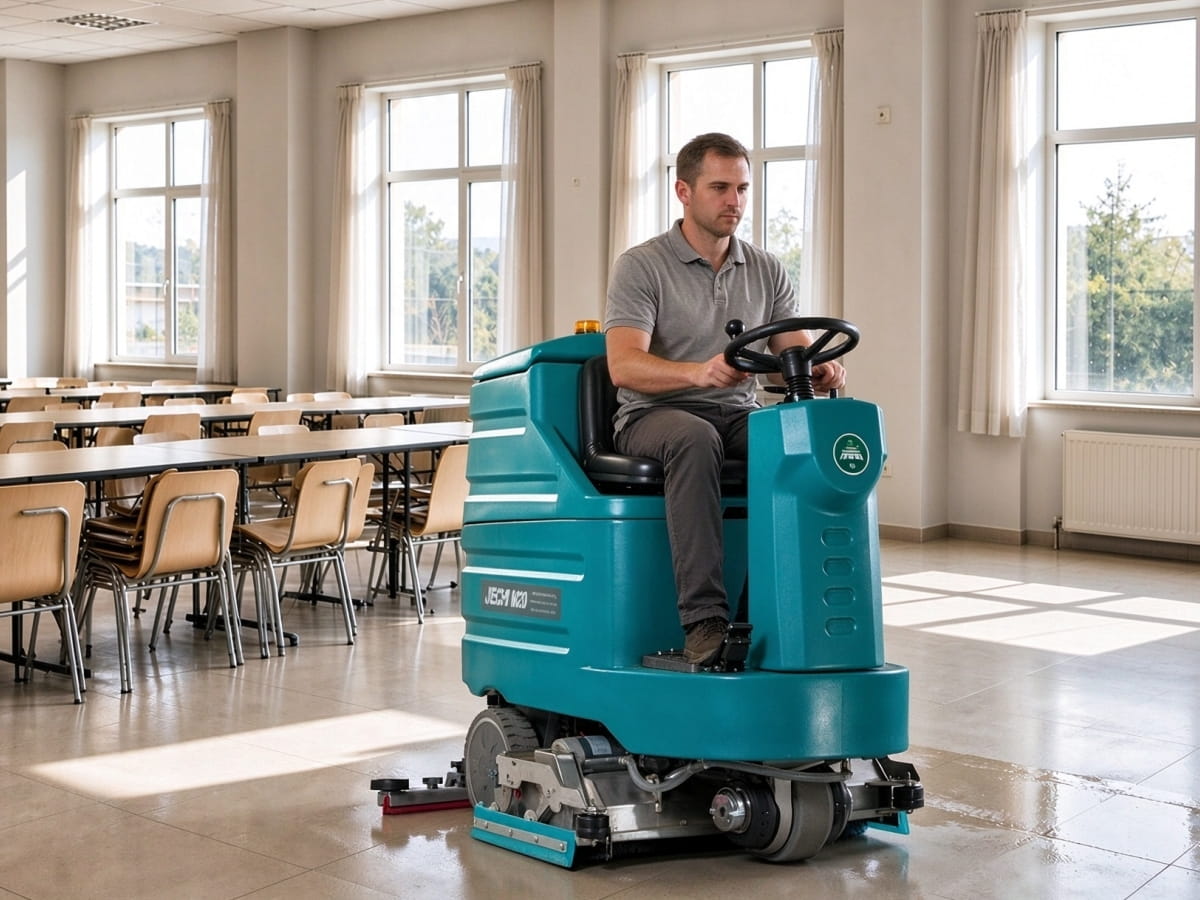
      Quick Answer School floor cleaning runs on two calendars. In term time you protect the floor: dry sweep corridors after breaks, spot-mop entrances, and scrub only what a day of foot traffic actually soils. In vacations you restore it, because that is the only window when a machine can work in an empty corridor.   Schools are the hardest commercial cleaning client to plan for, because the building changes personality four times a day. A corridor at 08:40 is a crowd. At 10:30 it is empty. At 12:15 it is a canteen queue. At 15:30 it is a stampede.   Campus cleaning plans that survive contact with reality are built around that rhythm rather than against it. Here is how we would set one up, from zone map to holiday programme.   Zones: classrooms, corridors, gyms, canteens   Four zones, four different soils.    Classrooms. Low soil, high furniture density. Chairs and desks mean a machine is slower than a mop here. Hand cleaning wins, with a machine pass once a week down the clear edge.   Corridors. The highest-traffic floor in the building and the one that shows dirt first. Vinyl and safety flooring, both of which mark easily and both of which parents notice on open day.   Gyms. Rubber or timber, sweat and resin. Water volume matters here, and so does drying time, because a wet gym floor is a liability.   Canteens. Grease, food debris and drink spills, all within a 40-minute window. This zone needs the most frequent attention and the strongest chemical.   Our A3 walk-behind scrubber is the machine most campus teams end up with for corridors and canteens: 530 mm scrub width, 770 mm suction, 2,200 m²/h, 50 L clean and 55 L recovery. At 127 × 55 × 109 cm and 155 kg it fits a standard door and a service lift without a ramp.     Vacation deep clean and floor restoration   Holidays are when the floor gets the work it has been waiting for: two weeks, an empty building, nobody to move off the floor. This is the school vacation deep cleaning window, and it is short.   Machine scrub everything reachable. This is where a larger machine earns the spend. Our M20 scrubber-sweeper covers 5,500 m²/h with a 900 mm brush and 1,080 mm suction width, and it sweeps and scrubs in one pass. That matters in a canteen, where debris and grease arrive together. Its 20 L dust box means the crumbs go in the bin rather than into the recovery tank.   Gym floors. Deep clean, check the finish, and let it dry for a full day before any equipment goes back.     Safety around children: machine training   A school is the one client where the cleaning schedule and the safeguarding policy have to be written by the same person.   Machines. A scrubber running a corridor at 09:00 is a moving hazard with children moving faster than judgement. Machines work after the last bell, full stop. If a daytime pass is unavoidable, it runs behind a barrier with an adult at each end.   Training. Two named operators per machine, not one. The second one is who covers a sick day and who notices when the squeegee starts streaking.   From the field: the machine that fits the service lift Jiechi(RCE) has built floor cleaning equipment since 2003 from two production bases totalling 60,000 m². Campus buyers ask about coverage first and forget the lift. A3 at 127 × 55 × 109 cm and 155 kg goes into a standard service lift and through a classroom door; a ride-on does not. Measure the lift and the narrowest door before you compare m²/h figures.   Campus-wide equipment standardisation   A campus with six buildings and four machine models has four sets of spares and no spare flexibility. University floor care contracts usually specify one standard, and there is a reason for it.   Model Best for Scrub / suction Tanks A3 Classroom wings, corridors, small canteens 530 mm / 770 mm 50 L / 55 L M20 Main corridors, gyms, dining halls 900 mm / 1,080 mm + 20 L dust box   Both run 24V battery systems with no trailing cable in a building full of children, and both use the same consumable family. That last point is the one that saves money: one pad, one squeegee profile, one order.   A 24V lead-acid pack also means a charging point in a caretaker's room rather than a three-phase supply, which most older school buildings cannot offer without an upgrade.   FAQ Can school floors be machine cleaned during the school day? Only in a closed zone with barriers at both ends, and only if the floor dries before the next break. Most schools schedule machines after the last bell instead. How often should school corridors be scrubbed? A full mechanical pass daily after school in high-traffic corridors, and a lighter pass in classroom wings two or three times a week. Entrances need attention twice a day, not once. What is the best floor cleaning machine for a school? Usually a walk-behind scrubber around 530 mm for corridors and canteens, plus a larger scrub-sweeper for dining halls and gyms. The walk-behind is the one that fits doors and lifts. When is the best time for a school vacation deep clean? The first half of the longest break. Finish with time left for floors to cure and rooms to dry before staff and students return. Plan a campus cleaning programme Send us your building count, corridor lengths and lift dimensions. We will map the zones and tell you which machines fit the doors you actually have. Tel: +1 2403149021  |  Email: kliu@jiechi.com
  • How to Tackle Multi-Storey Car Park Floor Cleaning: Oil Drips, Ramps and Drainage Issues
    Oct 23, 2026
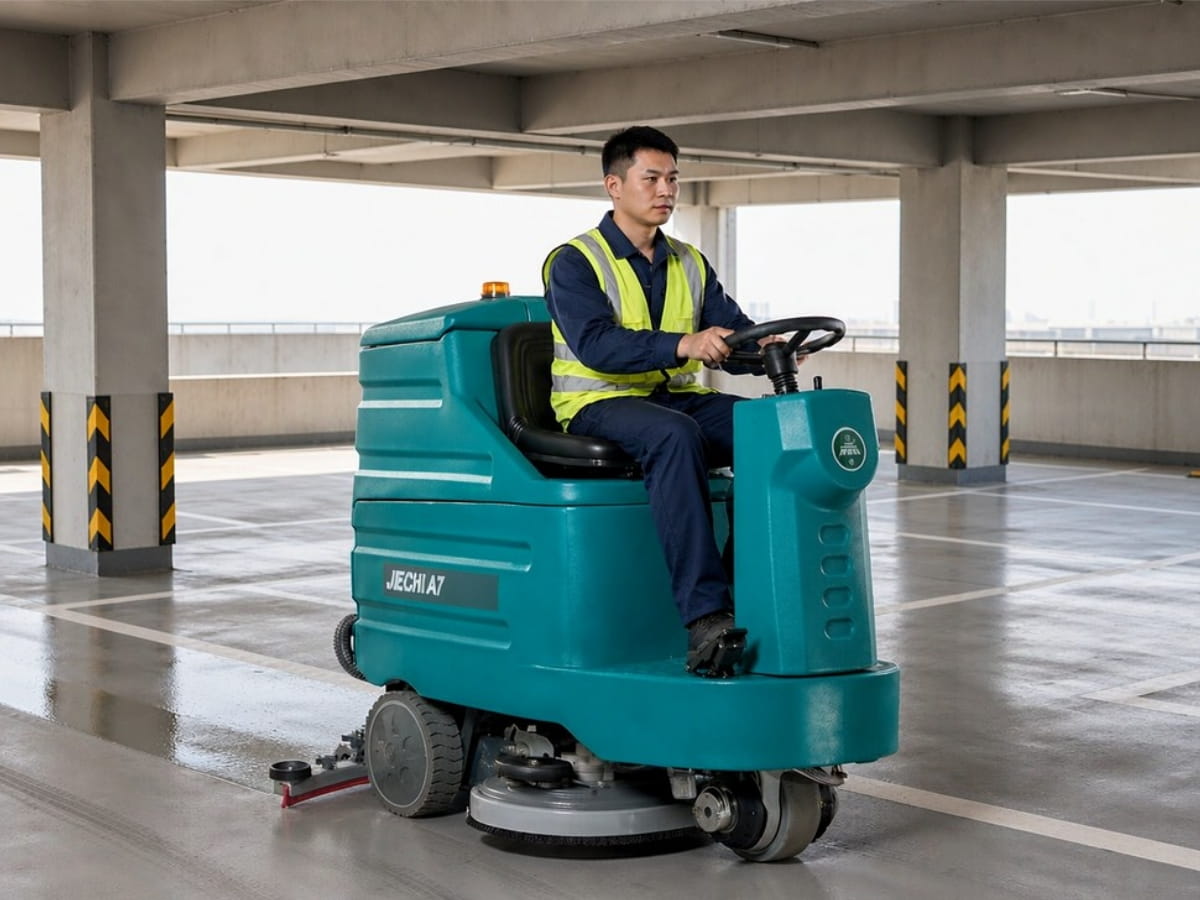
      A car park collects everything a building does not want: grit, brake dust, oil drips, leaves, spilled coffee, shopping trolleys. None of it arrives on a schedule, and all of it ends up on the floor.   Clear grit and litter before you wash. Size the machine to the tightest space it must enter, not to the square metreage of the deck. Then match the scrubber to the space: a walk-behind for ramps, columns and lift lobbies, a mid-size ride-on for standard decks, a large ride-on only where you can close a whole level.    Ramps, corners and low headroom   Geometry decides machine choice more often than square metreage does. Before you buy, measure three things: the clear width of the tightest aisle you must clean, the height of the lowest beam or pipe on that route, and the gradient of the steepest ramp.   Area Constraint to measure Practical approach Large open decks Aisle width, slab load, level access Large ride-on, whole level closed Standard decks Bay-to-bay aisle, turning radius Mid-size ride-on, one pass per aisle Ramps Gradient, surface texture Walk-behind, slow, dry pass first Column surrounds Turning space around columns Walk-behind, figure-of-eight pattern Pedestrian routes Door widths, lift lobby Walk-behind, off-peak only   Gradient matters twice: a machine that cannot hold a ramp is a safety problem, one that leaves water on a slope is a slip problem. Check the rated climbing angle against your steepest ramp, and ask how dry the squeegee leaves the floor.   Walk-behind, mid-size ride-on or large ride-on?   Three sizes cover almost every multi-storey site, and the split follows geometry rather than budget. The tightest clear width eliminates one of them before price comes into it.   Specification BA530BT walk-behind A7 mid-size ride-on A17 large ride-on Cleaning width 530 mm 860 mm 1,060 mm Squeegee width 770 mm 1,100 mm 1,400 mm Rated coverage 2,100 m²/h 5,500 m²/h 8,600 m²/h Solution / recovery 50 L / 55 L 140 L / 150 L 300 L / 350 L Battery 24 V 100 Ah 24 V 200 Ah 36 V 460 Ah Machine size (L×W×H) 116 × 54 × 106 cm 165 × 90 × 130 cm 223 × 140 × 148 cm Weight with battery 190 kg 330 kg 1,525 kg Best fit Ramps, columns, lobbies Standard decks, long aisles Whole-level closures     The BA530BT walk-behind scrubber puts a 530 mm brush and 770 mm squeegee on a 116 × 54 cm chassis of 190 kg: the machine for ramps, column surrounds and the walkway to the lifts. Its 50 L tank is an advantage on a slope, not a limitation.   The A7 mid-size ride-on scrubber is the deck workhorse: an 860 mm brush, a 1,100 mm squeegee, 5,500 m²/h and 140 L of solution on a 330 kg body. Its turning circle is tight enough to swing at the end of an aisle instead of reversing out.     The A17 large ride-on scrubber covers 1,060 mm per pass at 8,600 m²/h with 300 L of solution and 7–8 hours on one charge, but it stands 223 × 140 cm and weighs 1,525 kg. It earns its place only where you can close a whole level: airport parking, exhibition centre decks, mall car parks with wide aisles. Check the slab load rating first.   From the field: three sizes, one site Jiechi(RCE) has built cleaning equipment since 2003 across two production bases totalling 60,000 m². Car park enquiries reach us as one area and one budget, so the first thing we split is the deck map.    FAQ Can one machine be universally applicable? Generally, analysis needs to be carried out considering the floor material, the narrowest passage and the total working area. JIECHI scrubber dryers can handle a wide range of floor surfaces including epoxy flooring, cement floors, terrazzo, ceramic tiles, PVC vinyl flooring, marble and emery floors. Is a parking garage floor scrubber different from a warehouse one? The machine is the same class. What changes is the specification: gradient capability, how dry the squeegee leaves the floor, and a footprint that fits the tightest aisle. Plan a machine split for your decks Send us your deck plan, tightest aisle width, ramp gradient and the hours you can close a level. We will tell you which of the three sizes belongs on each deck. Tel: +1 2403149021  |  Email: kliu@jiechi.com
  • Food Plant Floor Cleaning by Sanitation Zone
    Oct 21, 2026
    Food plant floor cleaning holds up when the zone decides the method and the machine follows. Dry lift in high-care rooms, controlled wet cleaning at changeover, squeegee-dried floors and signed-off drains do more for a hygiene score than any single machine. Verify it with swabs on a fixed sampling plan, and keep records a crew will maintain on the worst shift of the week.   A food plant is not one floor. It is a series of floors with different rules, joined by corridors that belong to nobody in particular, and a single failed method in the wrong room can cost a customer contract. So generic advice for food processing hygiene floors falls apart on site. "Wash down every shift" sounds disciplined until someone drags a wet squeegee past an open product line.   Zone classification and cleaning requirements   Most plants carry a zoning map in their HACCP plan, and HACCP floor cleaning starts by reading it: Zone 1 for product contact, Zone 2 for frames that could transfer contamination with a mistaken touch. High-care floors sit on that boundary, which is why auditors ask about them. The useful split is high-care, medium-care, low-care and perimeter.   Zone Water policy Typical machine High-care, ready-to-eat Dry pickup in production. Controlled wet cleaning at changeover, dried at once. Compact walk-behind, low flow, or wet-dry vacuum Medium-care prep and packing Wet cleaning between runs, floor signed until dry Walk-behind scrubber, 500–600 mm brush path Low-care stores and logistics Wet cleaning any shift, foam permitted Ride-on scrubber, wide squeegee Perimeter and waste bays Unrestricted, runoff must leave the food area Pressure washing, external drains   For hard-to-reach plant, a walk-behind scrubber such as the Jiechi BA680BT is a practical compromise. Its 530 mm brush path and 770 mm suction width reach between prep-room line legs a ride-on cannot, and the 2200 m²/h rated output lets one operator cover the medium-care block in a shift. The 68 L clean and 70 L recovery tanks keep most prep rooms going without a refill.   The interface that catches plants out is the door between zones, and it is where sanitation zone cleaning quietly fails: a machine coming from a low-care store into a high-care room carries wheels, brushes and squeegee edges loaded with the previous floor. Either assign a machine per block, or make a wheels-and-blades clean at the boundary a signed task.   Equipment materials for food environments   A scrubber in a food plant lives harder than in a supermarket: bumped into steel legs, washed with caustic, left in a damp store, expected to start at 5 a.m. Body and tank build decide whether it lasts three years or eight. Moulded tanks survive knocks better than steel panels that dent and hold water at the fold, and aluminium brush covers avoid the rust creep that starts on painted steel at the first chip. Wear parts should come off without tools: an operator who needs a spanner to change a squeegee blade will run a streaking one all week.   Check the openings too. A wide lid and smooth interior drain completely; ribs and a narrow outlet leave a film that is a contamination point by Friday. And check the machine comes apart round the brush deck, because what sits under the guard is what the auditor asks to see. On power, a lithium pack can be opportunity-charged between zones; sealed lead-acid is cheaper where an overnight window exists.     For wide corridors and cold stores, a ride-on covers ground far faster. A dual-brush ride-on scrubber like the Jiechi A7 runs an 860 mm brush path and a 1,100 mm squeegee at a rated 5500 m²/h, with 140 L clean and 150 L recovery tanks. The turning circle matters more than the width in a food building: it turns on the spot at the end of a narrow aisle instead of reversing into a racking leg.   From the field: spec the machine to the zone, not the plant Jiechi has built cleaning equipment since 2003 across two production bases totalling 60,000 m². The most common mistake in food projects is one wide machine bought for the whole building: it will not fit between prep-room line legs, so the high-care rooms go back to mopping. Our usual answer is one compact walk-behind per high-care block, one ride-on for corridors and cold stores, and colour-coded squeegee blades at the store. FAQ Can I use one scrubber across all zones? Mechanically yes, hygienically no. Wheels, brushes and squeegee edges carry soil room to room, so a shared machine needs a documented clean at every boundary. A unit per high-care block is usually cheaper than that compliance work. Do we need a ride-on at all? Only if you have the area. Corridors and dry stores above roughly 3,000 m² pay back a ride-on quickly. Below that, a walk-behind wins because it spends less time turning. Match a machine to your zone map Send us your zone layout and floor areas. We will recommend the walk-behind and ride-on split that fits each area Tel: +1 2403149021  |  Email: kliu@jiechi.com
  • ROI of Switching from Mopping to a Floor Scrubber: Worked Example
    Oct 20, 2026
      Quick Answer The machine wins on hours, not on kit price. Budget manual mopping at roughly 5,000 sq ft per labour hour once bucket changes and edges are counted. Plan a 530 mm walk-behind at 12,000 to 13,000 sq ft per hour. On 40,000 sq ft cleaned nightly, that turns eight labour hours into about three and a half.   Baseline: what manual mopping really costs   Start where the mop actually is. A person wet mopping an open corridor covers ground quickly for about ten minutes, then slows: wring out, move the bucket, shift a chair, wait for the section to dry, redo the patch somebody walked across.   A genuine mop vs scrubber cost comparison counts every line: replacement mop heads, laundering where you use it, buckets and wringers, wet floor signs, detergent, two or three water changes a shift, and the minutes lost when a spill has to be boxed off and redone. Individually these are rounding errors. Across a year they are a budget line.   Nobody writes down consistency either. Hand pressure varies, dilution drifts, and by the fourth bucket the water is grey. The floor looks acceptable and tests badly, which is why complaints tend to arrive months before the cost review.   Effective rate: mop vs walk-behind vs ride-on   Rated coverage assumes clean, straight runs. Model against an effective rate, which is what your team delivers when the aisles are half full. Method Working path Planning rate Where it fits Wet mop and bucket About 0.5 m 400–500 m²/h (4,300–5,400 sq ft/h) Small rooms, washrooms, spot work Walk-behind scrubber 530-860 mm 1,500–4,200 m²/h (12,000–14,000 sq ft/h) Retail aisles, clinics, schools Ride-on scrubber 530–1060 mm 2,700–8,600 m²/h (21,000–30,000 sq ft/h) Open halls, logistics   Those planning rates drive most labour savings floor cleaning models, which is why timing your own shift beats quoting someone else's figure. Rate also matters less than fit: a machine that cannot turn in your tightest aisle gives back every minute it wins down the long one.   Redeployed hours vs reduced hours - the honest distinction   This is where most cases lose their audience. Hours freed by a machine do not all convert to cash. Some become detail work you were quietly skipping: edges, door tracks, and spill response nobody formally owned.   Split them into two lines. Reduced hours leave the payroll, redeployed hours improve the building. Put both in the table, because finance will find the difference if you do not.   A mechanised cleaning ROI figure should rest on the reduced column alone. Redeployed hours have value, but it is a quality argument, and blending the two is how a credibility problem starts.   Then apply your own labour rules. Minimum shift lengths, collective agreements and part-time contracts all decide how many hours can genuinely come off. Two hours saved nightly means little to someone on a three-hour minimum.   Worked 3-year example for a 50,000 sq ft site   Take a 50,000 sq ft site cleaned five nights a week. Not every square foot gets mopped, so it is the cleanable hard floor that matters. Every input below is a placeholder; swap in yours and the table recalculates.   Input Value used Where to get your own Cleanable hard floor 40,000 sq ft (3,700 m²) Drawings minus fixtures, racking and carpet Frequency 260 nights per year Current cleaning schedule Manual effective rate 450 m²/h Time one full shift Scrubber planning rate 1,200 m²/h plus 0.4 h detail Path width times walking pace Fully loaded labour rate $22 per hour Payroll plus on-costs   The arithmetic is short. Mopping takes 3,700 ÷ 450, about 8.2 hours a night. Scrubbing takes 3,700 ÷ 1,200, about 3.1 hours, plus 0.4 for edges: call it 3.5. That frees 4.7 hours a night. Assume 2.7 of those leave the payroll and 2.0 move into detail work that was not happening.   Line Year 1 Year 2 Year 3 Payroll hours removed 702 702 702 Labour value at $22/h $15,444 $15,444 $15,444 Machine amortised over five years ($7,500) −$1,500 −$1,500 −$1,500 Pads, brushes, squeegee blades, service −$1,200 −$1,200 −$1,200 Detergent, water and charging −$500 −$500 −$500 Purchase price, one-off −$7,500 — — Net cash effect $4,744 $12,244 $12,244   Three-year total of about $29,200 against a $7,500 machine, so payback lands inside year one. Add roughly 520 hours a year of detail work now getting done, worth $11,400 at the same rate if you were otherwise paying for it.   The shape matters more than the numbers. Move the labour rate and the result moves in a straight line; move the planning rate and it moves faster, because coverage drives every other line. A model that survives only when everything goes right does not survive.   Size the machine to the floor first. A walk-behind scrubber like the Jiechi A3 works a 530 mm brush path behind a 770 mm squeegee, carries 50 L solution and 55 L recovery, and rates 2,200 m²/h. At 155 kg it is light enough for one person to unload and heavy enough to track straight down an aisle.     Where the same area is split into rooms rather than long aisles, the operator should be sitting down. The Jiechi A5 keeps a 530 mm path on a 126 cm body, rates 2,700 m²/h, carries 65 L and 75 L, and turns inside a lift lobby without a second person spotting.   Quality and safety gains that do not show in the maths   Some of the value never reaches a spreadsheet, and it is usually what gets the decision over the line.   Gain What it protects Floor left almost dry behind the squeegee Slip exposure during and after the shift One detergent dilution all night Floor finish and grout, plus fewer early strips Repeatable result on every run Audit scores and inspection outcomes No wringer trolleys in public corridors Customer experience and insurance questions Less bending and wringing per shift Staff retention on a hard-to-fill roster   None of this pays this month's wages. It stops money going out later: a claim, a floor stripped a year early, or a failed audit.   From the field: what we ask for before quoting Jiechi has built floor cleaning machines since 2003 across two production bases totalling 60,000 m², and the enquiries that end in an order usually start with a timed shift rather than a price request. Send us the floor plan, the cleaning frequency and the night roster. We will run this same three-year table with your numbers and size the machine to it, even when that turns out smaller than the one you asked about. What size of site makes the switch worthwhile? Look at hours, not area. Once the nightly mop takes more than about four labour hours, a walk-behind usually pays for itself inside a year. Below that, it depends on your labour rate. What usually gets missed in the budget? Squeegee blades, brush and pad wear, a battery reserve after year three, and somewhere secure to charge and empty the machine. Send us your floor plan and roster Tell us the floor area, how often it is cleaned and how many hours it takes.  Tel: +1 2403149021  |  Email: kliu@jiechi.com
  • Factory Floor Cleaning Program for Audit Readiness: ISO, 5S and Customer Visits
    Oct 17, 2026
     What auditors look at on the floor   ISO 9001:2015 treats the environment your processes run in as something you must determine and manage, cleanliness included. In a machine shop that means oil under a lathe, swarf in an aisle, water tracked in from the dock. Inspectors turn it into plain questions: how often, who checks, where is it written down. That is ISO 9001 floor cleaning in practice.   What 5S adds. 5S gives you a vocabulary the auditor already knows. Shine is the cleaning step, but Standardize and Sustain are the ones that get tested, because they are about a written standard followed by somebody other than its author. On 5S factory floors, that usually shows up as a board in the aisle with the week's sign-off on it.   Zone map: production, warehouse, walkways, loading   One program for the entire site is why cleaning plans fall apart at audit. Soil, traffic and risk differ by zone, so the task list has to differ too. Draw it on a print of your layout and give each zone an owner.   Production. Coolant mist, hydraulic oil, metal fines, plastic dust. The hard part is the perimeter: the machine base, the cable tray shadow, the space behind the chip conveyor. Cleaning here has to reach the edge without pushing fines into a drain.   Warehouse. Tyre marks, pallet dust, and the polished patch where a forklift brakes at the end of a run. Aisles are long and open, which is where wide ride-on machines earn their keep, provided they can turn at the end without a shuffle.   Walkways. Foot traffic, handover points and door entries. This is what a visiting customer sees first, and it is usually the zone with no owner. Marked lanes make the standard visible and give you a boundary to point at.   Loading. Grit, diesel soot, rainwater, the odd broken pallet. The dock door line is where the outside arrives. A mat and a sweep routine there cuts the soil load on every zone inside, and it is the cheapest decision on this list.   Cleaning without stopping production Production will not pause for the floor, so the program has to fit the gaps that exist: changeovers, breaks, shift handover and the hours after last shift. Battery machines help here for a reason that has nothing to do with power. No mains cable means no trip hazard strung across a walkway, which is a finding on its own, and no lead to drag around a running line.   Work the site in slices. Clean one aisle at a time, dry it before traffic returns, and plan the route around the turning circle rather than straight-line speed. A route needing three-point turns in a two-metre aisle takes twice as long as the spec suggests.   Drying time decides whether the task survives. A squeegee in good condition and sensible brush pressure leave a floor that takes foot traffic in minutes. If the floor is still wet when the next shift walks in, the task gets dropped within a fortnight, whatever the sheet says.   From the field: what actually decides the machine Jiechi has built scrubbers and sweepers since 2003 across two bases totalling 60,000 m². When a plant layout lands with us, the useful questions are almost never about total area. They are about where soil collects, which aisles take traffic, and when the floor is free of people and pallets. Those three answers set the machine class and the pass pattern. We size to the window you have, not to the number on a brochure. Machine choice by zone Buy to the zone, not to the biggest area on the plan. One large machine for everything ends up too wide for the production aisle and too slow to turn in the warehouse. Zone Machine class What to look for Production Ride-on scrubber, dual brush 850 to 1,000 mm scrub width, tight turn radius, low noise for changeover work Warehouse Ride-on scrubber or combination unit Long run time, tanks over 200 L, good transport speed Walkways Compact walk-behind Under 800 mm, useful edge cleaning, quiet enough for daytime Loading Sweeper-scrubber combination Debris hopper, suction path over 1.2 m, dust control on dry days   For the two biggest zones, an industrial ride-on scrubber with dual brush carries the middle of the plant: 860 mm on the A8 and 1,015 mm on the A10, with 280 L of solution and 300 L of recovery on a 36V/220Ah pack, rated at 6,500 and 7,000 m²/h. Two brush motors give the pressure to lift cured coolant film a single brush skates over.   Where the floor is half outside, grit has to be swept before it can be washed. The large ride-on sweeper-scrubber M17 does both in one pass, rated at 8,600 m²/h with a 1,400 mm suction path, 300 L solution and 350 L recovery on 36V/460Ah. It is the machine for the dock approach, not the aisle beside line three.   Whatever you shortlist, ask for the demonstration on your floor, in your narrowest aisle, at the hour you would really clean. A machine that only performs in an empty warehouse will not last a month.   FAQ How often should a factory floor be machine scrubbed? Daily in production aisles and walkways, weekly in loading bays, plus a deep clean at each planned shutdown. Set it by how fast soil returns. What records does an audit expect for floor cleaning? Enough to follow one date backwards: task, zone, frequency, who signed it and what was used. Photos from fixed viewpoints once a week are usually enough. Who should own the cleaning program? One named person per zone, not a department. Where cleaning belongs to everybody, nothing gets signed. Can we clean while the line is running? Yes, in slices. Battery machines remove the cable hazard, a good squeegee returns the floor to traffic in minutes, and the route should avoid the busiest aisle at peak times. Build your zone map with us Send us your layout, floor area and production windows. We will map the zones and size a machine to each one. Tel: +1 2403149021  |  Email: kliu@jiechi.com
  • Automotive Plant and Dealership Floor Care: Oil, Tyre Marks and Showroom Finish
    Oct 15, 2026
      Automotive dealership floor cleaning comes down to treating three zones as three jobs. Absorb oil before you scrub it, take tyre marks off with pads and dwell rather than pressure, and put the showroom on a burnishing schedule instead of waiting for it to look dull. Do that and the floor stops being the thing customers notice. Three zones, three standards. One routine across workshop, bay and showroom fails two of them. Fresh oil is an absorbent job first. Water spreads the film and makes the next hour worse. Tyre marks sit on the coating, not in it. Pad choice and dwell decide what comes off. Three different floors: workshop, service bay, showroom   A dealership is three floor problems sharing one roof. The workshop takes engine oil, coolant and metal fines. The service bay takes hot tyre marks, jack drips and brake dust. The showroom has to look as good as the cars on it. Zone What lands on it Typical floor What clean means Workshop Engine oil, coolant, metal fines Bare or sealed concrete No slip film, no oily odour Service bay Tyre marks, hydraulic drips, brake dust Epoxy or polyurethane-coated concrete Marks gone, coating intact Showroom Foot traffic, dust, water spotting Polished concrete, terrazzo or tile Even gloss, no haze or swirls   Area decides machine width in the workshop. A 4,000 to 7,000 m² workshop with bays down both sides is ride-on territory, and the wider you can scrub in one pass the fewer hours you spend in traffic. The JIECHI A8/A10 industrial ride-on scrubber comes in two widths, 860 mm on the A8 and 1,060 mm on the A10, with rated coverage of 6,500 and 7,000 m²/h.   Oil and coolant spill response   The first thirty seconds decide whether this is a five-minute job or a half-day one. Oil is a film, and water spreads a film, so reach for absorbent before the hose.   Contain, then pick up dry. Cones around the edge, absorbent granules or a sock, then sweep or vacuum the loaded absorbent. Anything removed now is liquid you never have to recover. Walk the perimeter before you start so nobody tracks it into the showroom.   Degrease with dwell. Apply at the label rate and give it the full contact time. Cutting dwell short is why floors look clean wet and greasy dry.   Scrub, recover, rinse. Scrub and recover in the same pass, then a rinse pass with clean water. Detergent residue becomes a hazy film that grabs the next spill.   Coolant behaves differently. It is largely water-miscible, so it dilutes and recovers easily, but it carries fine metal that settles in the recovery tank. Empty and rinse the tank rather than leaving it overnight. An oil stain concrete floor is a different problem from a spill. Once oil has soaked into bare concrete it keeps wicking back, so the stain returns. Sealing the floor is what ends that cycle.   Recovery capacity limits you here, not brush power. The A8/A10 carries a 280 L solution tank and a 300 L recovery tank, and the recovery side being larger is the point: you pick up more than you lay down when rinsing degreaser off a big floor. If you want one single machine for both garbage collection and floor cleaning, choose the M10. This is a sweep‑scrub integrated machine that delivers both functions. It shares the same tank capacity as the A10, yet comes with different functions.   Tyre mark removal without damaging coatings   A tyre mark is not dirt. It is rubber and plasticiser transferred by a hot tyre under load, and it sits on top of the coating rather than in it. On a sound coating most marks come off with the right pad and enough dwell.     Go softer than you think. Aggressive stripping pads take the mark and the gloss in one pass, and the repair is a re-coat rather than a re-clean. Start with a red or white pad and a neutral cleaner, and move up a grade only where a mark refuses to shift.   Slow passes and extra dwell beat extra pressure. Pressure on a coated floor is what leaves the dull patch you then have to polish back.   Test first. Pick an inconspicuous corner, run three passes, dry it and look at it in customer lighting. If the sheen has changed, change the method before you work a visible lane.   Find out what you are cleaning. Epoxy, polyurethane and acrylic sealers tolerate different chemistry, and the coating data sheet gives you a pH ceiling. If nobody knows what is down, treat the floor as the most delicate of the possibilities.   Showroom gloss: polishing schedule   Gloss is easier to keep than to restore. A light burnish two or three times a week keeps the surface reflective and hides the micro-scratching daily traffic puts into it. Waiting until the floor looks dull means restoring, not maintaining.     Car showroom floor polishing also happens around customers, which rules out trailing a mains cable across the floor. The JIECHI BA2510BT battery polisher runs on 36 V / 100 Ah with a 530 mm working width and 2,200 rpm, rated at 2,800 m²/h, so a typical showroom is a short job.   Machine and chemistry combination   Most floor complaints trace back to a mismatch, not a bad product. Strong degreaser in the showroom leaves residue that dulls the gloss; neutral cleaner in the workshop never touches the oil, so the dose goes up and the floor gets stickier.   FAQ How often should car showroom floor polishing be done? Two or three times a week for a burnish, daily for dust removal. Increase it on the main walkway, reduce it on the perimeter. Can one machine handle the whole dealership? A ride-on scrubber covers the workshop and most of the service bay. The showroom needs a burnisher. What is the safest way to treat an oil stain on a concrete floor? Absorb the free liquid first, degrease, scrub and recover, then rinse. Should workshop floor cleaning use hot water? Warm solution helps on heavy grease, but dwell time and the right degreaser matter more. Check machine and coating limits first. Plan your dealership floor programme Send us your workshop, bay and showroom areas plus floor types. We will size the scrubber, polisher and vacuum. Tel: +1 2403149021  |  Email: kliu@jiechi.com
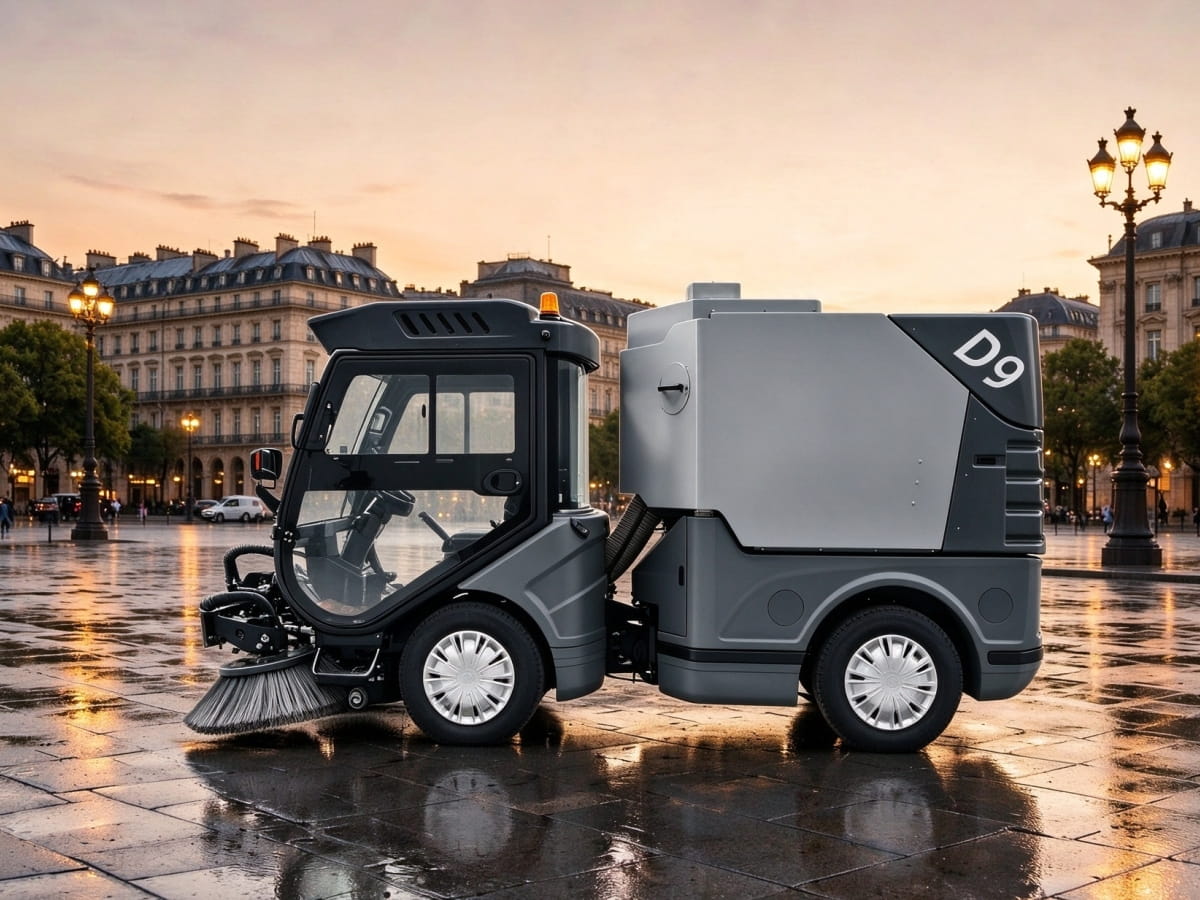
  • Lithium Road Sweepers D9 vs Diesel S9 : Operating Cost and Access Compared
    Oct 13, 2026
    Quick Answer Choosing the right sanitation vehicle takes many factors into account. A lithium road sweeper vs diesel decision usually turns on two numbers. Diesel costs about $33 per eight-hour shift at 3.2 L/h. A 48 kWh lithium sweeper recharges for roughly $7. Lithium also wins on night routes and emission-zone access. Diesel still wins where there is no charging window.  Key Takeaways Energy is the biggest swing: roughly $33 of diesel per shift against roughly $7 of electricity. Low-emission zones and night routes are access questions. They decide more tenders than fuel does. Diesel keeps the edge on remote routes, sub-zero starts, snow duty and double shifts without charging. The tender sets routes, hours and noise limits, and the machine has to fit all three. Energy cost per shift compared   Jiechi's S9 multifunctional sanitation vehicle is rated at 3.2 L/h. Over an eight-hour shift that is 25.6 L, and its 70 L tank needs a top-up before a second shift.     Lithium is simpler again. The JC-D9 lithium battery road sweeper carries a 307.2 V, 48 kWh lithium iron phosphate pack. Budget around 53 kWh at the meter once charging losses are counted.   Line item Diesel (S9) Lithium (JC-D9) Energy per 8 h shift 25.6 L diesel 48 kWh + charging loss Unit price assumed $1.30 / L $0.14 / kWh Cost per shift ~$33 ~$7 Cost per year (250 shifts) ~$8,300 ~$1,850 Annual difference baseline ~$6,450 lower   Two things move that gap. Night tariffs can halve the electricity line, and route intensity matters: a diesel engine idling at a transfer station still burns fuel, an electric driveline does not.    Service intervals and consumables   Fuel is the loud cost. Service is the quiet one.   A diesel sweeper carries a full engine schedule: oil and filter, fuel and air filters, coolant, belts, plus hydraulic oil for the hopper and brush circuits. The S9 runs a Perkins 404EA-22 four-cylinder, so all of that applies.   A lithium machine deletes most of that list: no engine oil, no fuel or air filter, no exhaust aftertreatment. What stays is common to both: brush wear, hopper seals, suction hoses, tyres and the water spray system.   Service item Diesel Lithium Engine oil and filter Required Not applicable Fuel and air filters Required Not applicable Coolant and drive belts Required Not applicable Exhaust and aftertreatment Required Not applicable Hydraulic oil and checks Required Required Brushes, seals, hoses, tyres Required Required Traction pack health check 12 V starter battery only Cell balance, insulation resistance  Access to low-emission zones and night work   This is where the argument stops being about money.     City centres across Europe, and a growing list of Asian and Latin American metros, restrict diesel either through a low-emission zone or through the tender text itself. A diesel unit may be exempted in one scheme and barred in another, so read the actual wording of the zone you bid into.   Noise is the second access question. Jiechi publishes 69 dB(A) for the JC-D9, and that is what lets you run a night route past hotels or a hospital perimeter without building a complaint file. The operating noise of the S9 fuel sanitation vehicle is higher.   An emission zone sweeper also changes how you plan the shift. Quiet machines can start at 04:00 rather than 07:00, so the route finishes before traffic builds, and that is worth more to a city than the fuel saving. Payload, run time and terrain limits   Be honest about the route before you pick a driveline.   On volume the two are close. The S9 carries a 1.6 m³ hopper with one-touch hydraulic self-dumping; the JC-D9 carries a 1,850 L aluminium waste bin. Water tells a similar story: 320 L with sewage recirculation against 380 L. Sweeping width is adjustable on each, 1.4–2.2 m on the S9 and 1.6–2.2 m on the JC-D9.   Run time is where they separate. The JC-D9 is rated at 8 hours of sweeping endurance on a charge. The S9's 70 L tank at 3.2 L/h covers a long shift too, and refuelling takes minutes where recharging does not. A 16-hour double shift is honestly diesel territory. Working speed differs too: 12 km/h on the JC-D9 against a 24 km/h maximum on the S9, which matters on long transfer runs. Which fleet mix suits a city contract   Almost nobody goes all-electric in one purchasing round. The practical answer is a split.   Put lithium on dense centre routes, pedestrian zones, plazas, parks, stadiums and exhibition grounds, plus any night shift and anything inside an emission zone. The JC-D9 was drawn for that list, with a panoramic glass cab, integrated HVAC and an enclosed negative-pressure body that keeps dust inside the machine.   Keep diesel on peripheral routes and any shift pattern that cannot guarantee a charging window. The S9 multifunctional diesel sanitation vehicle is built for it.   FAQ What is the electric road sweeper cost per shift compared with diesel? At mid-range commercial rates, about $7 of electricity for a 48 kWh pack against about $33 of diesel at 3.2 L/h over eight hours. Your tariff and pump price decide the real gap. Can one lithium sweeper cover a double shift? Usually not without a charging window. Plan one machine per shift, or specify opportunity charging during the driver break, and confirm the pack warranty covers the extra cycles. Conclusion The lithium road sweeper D9 vs diesel S9 argument is settled on cost and access, not capability. Lithium wins the energy line and opens night and emission-zone routes. Diesel keeps remote routes, and double shifts. Map routes against run time and charging first, then let the tender decide. Talk to Jiechi about your fleet Send us your route list, shift pattern and depot charging capacity. We will size the lithium and diesel split and price both. Tel: +1 2403149021  |  Email: kliu@jiechi.com
1 2 3 4 5 6 7

leave a message

leave a message
If you are interested in our products and want to know more details,please leave a message here,we will reply you as soon as we can.
submit

Home

Products

WhatsApp

contact