Supermarket Floors: Cleaning Between Trading Hours Without Leaving a Slip Film
Nov 05, 2026
A supermarket floor is never dirty in one uniform way. Before the first shopper arrives, the entrance mats have already collected a night of grit, the produce misters have left a damp arc around the display, and the chilled cabinets have been dripping condensation onto the tile since the doors began cycling. By midday the checkout lanes carry a polish of shoe traffic and at least one spilled drink. None of that waits for closing time, and none of it is answered by shutting the store and mopping the whole floor once.
That is the real problem behind supermarket floor cleaning: the work happens with shoppers a metre away, and the surface has to be safe to walk on the moment the cone comes up. Below: the zone rhythm that makes short passes possible, where a slip film actually comes from, how aisle geometry decides between a compact ride-on and a walk-behind, and a pre-opening and midday pass you can hand to a shift leader as a written sequence.
Quick Answer
Cleaning a supermarket floor while the store trades means working one zone at a time, not one floor at a time. Close a single aisle with cones, run a low-solution scrub pass with immediate vacuum recovery, then check the surface at a grazing angle before you reopen it. The machine has to fit the clear width between gondola ends and the gap beside the checkout belt, and its squeegee blades must be sound so no detergent residue is left behind. Chilled cabinet door seals, produce misters and entrance matting keep re-wetting the tile, so they belong on a separate spot-check loop rather than in the main pass. A 530 mm scrub deck is the usual fit for retail aisles; larger industrial decks belong in the backroom or after closing. The deciding measure is not how fast the machine cleans — it is how quickly a cleaned strip can be handed back to shoppers.
Key Takeaways
Trade-hour work is zone work: one aisle closed, cleaned, verified and reopened before the next — never a whole-floor wet pass.
A slip film is usually a process fault, not a machine fault: excess solution, worn or badly angled squeegee blades, or a pass made too fast for the recovery system.
Measure the narrowest clear width between gondola ends and the gap between the checkout belt and the queue barrier; size the machine to that number plus a turning allowance, not to a brochure coverage figure.
A3 (50 / 55 L, 2,200 m²/h, 155 kg) and A5 (65 / 75 L, 2,700 m²/h, 220 kg) both use a 530 mm scrub deck; the choice is tank endurance, mass and operator posture, not cleaning width.
Chilled cabinet seals, produce misters and mat wells are recurring wet sources — fix the source before you scrub the symptom.
Rated coverage is a theoretical number. Time one full aisle including turns and build your pass window from the achieved rate.
Table of Contents
Why supermarket floors need a different cleaning rhythm
Aisle width
Where a compact ride-on fits and where a walk-behind wins
Why supermarket floors need a different cleaning rhythm
A warehouse floor is cleaned against one clock: how long until the shift starts. A supermarket floor is cleaned against two. The store clock says the aisle must be trading again; the drying clock says the tile is not ready yet. Every decision about supermarket floor cleaning sits between those two clocks, which is why a method borrowed from a distribution centre fails on a grocery shop floor even when the machine is the same.
The first change is the unit of work. In a warehouse the unit is the floor; in a supermarket it is the strip. You close one run between two gondolas, clean it, verify it, take the cones away, and only then move to the next. Shoppers detour around one closed aisle without noticing; they cannot detour around a wet perimeter that encircles the store. That single change also removes the most common complaint about cleaning between trading hours — that the cleaning team is always in the way — because at any moment only a short section is out of use.
The second change is the order. Dirt arrives in a supermarket in a predictable sequence: grit at the entrance, moisture and leaf litter at produce, condensate along the chilled run, shoe polish at the tills, crumbs wherever samples are handed out. A written route puts those zones in a fixed order so the operator is not deciding under pressure which one to hit next, and so the wet sources are dealt with before they can spread down an aisle on a trolley wheel. If you are building this from scratch, a retail and supermarket floor cleaning programme gives you the zone vocabulary; your own store plan gives you the distances and the timing.
The third change is visibility. A retail floor cleaning machine works within arm's reach of a queue: cones go at both ends of the strip, the operator must be able to stop instantly, and no hose crosses the open side. On a ride-on, the seated position and low front deck make a crowded aisle harder to read.
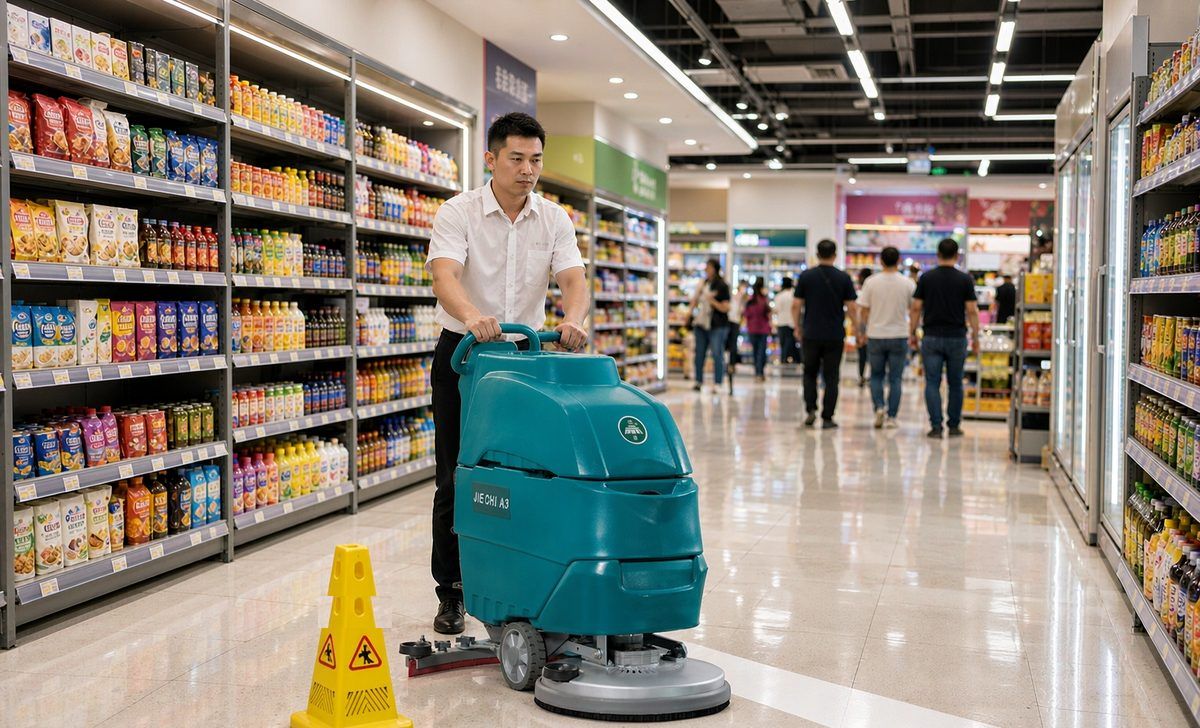
One aisle closed, the rest of the store trading: the cone marks the boundary of the strip, not the boundary of the cleaning shift.
None of this is about working faster. It is about making the wet window short, local and verifiable — which turns machine selection into a question of fit and the drying question into a checklist.
Aisle width
Supermarket floors are a set of obstacles, not an open plane. Before choosing a supermarket floor scrubber, walk the store with a tape measure and record three numbers: the narrowest clear width between two gondola ends, the gap between the checkout belt and the queue barrier, and the clear turning space at the end of the longest straight run. Compare them with the machine's overall body width plus a turning allowance. Rated coverage in m²/h is calculated from deck width and travel speed on an empty floor; it says nothing about whether the machine can get around a promotional pallet without clipping it.
Wet scrubbing without leaving a slip film
A slip film is the residue left after the machine has passed. The floor can look dry and still be slick — which is why a pass can be technically finished and operationally unusable. It comes from five places: too much detergent, a dose unmatched to water hardness, squeegee blades that are worn or set at the wrong angle, a speed that outruns the vacuum, or a second wet pass over a strip already drying.
Work through them in that order: the first three are settings, the last two are behaviour. Dose to the detergent label at the lowest effective concentration and log the batch — more product leaves more to be recovered. Check the blades at the start of every pass for nicks and even contact, replace them as a set, and set travel speed by what the vacuum can pick up, not by the shift schedule.
Solids and free liquid are collected before the machine arrives; a scrub deck should never be the first tool on a spill like this.
For slip-resistant floor scrubbing during trading hours, the most useful habit is the dry recovery pass: shut off solution flow and run the same strip again with the squeegee and vacuum only. It removes the residue a single pass leaves at turns, where speed drops and dosing continues. Make it standard on cold tile — and never re-dose a strip that is already drying.
Verification must be repeatable, not a judgement call. Before the cones come up: look along the strip from a low grazing angle for a continuous sheen, press a clean white cloth to the tile and check for moisture transfer, then walk the strip the way shoppers will. If any check fails, run the dry recovery pass again. A cone is a statement about the floor, not the machine.
Where a compact ride-on fits and where a walk-behind wins
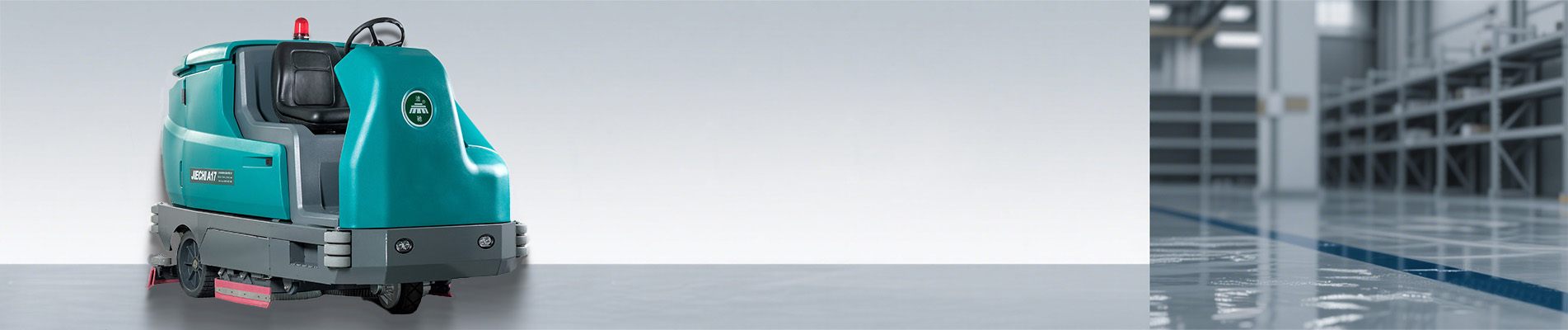
The two machines most often compared for a grocery floor are deliberately similar at the business end. A3 and A5 both carry a 530 mm scrub deck, both run a 24 V / 100 Ah pack, and both are short enough to work a gondola run. What separates them is tank endurance, mass and how the operator sits or stands — which is exactly what a trading-hours routine is sensitive to.
Specification
A3 walk-behind
A5 compact ride-on
Scrub width
530 mm
530 mm
Suction width
770 mm
per datasheet
Solution / recovery tanks
50 / 55 L
65 / 75 L
Rated coverage
2,200 m²/h
2,700 m²/h
Machine weight
155 kg
220 kg
Dimensions (L × W × H)
127 × 55 × 109 cm
126 × 62 × 103 cm
Same 530 mm deck, different operating posture: the choice is about tank stops, visibility and turning room, not scrubbing width.
A compact ride-on earns its place on long, straight, repeatable work: the perimeter run, the backroom, wide ambient aisles after opening, and any route an operator would otherwise walk several times a shift. Larger tanks mean fewer refill stops across a sequence of strips, and seated operation reduces fatigue when the same route is run daily. For that duty, a 65 L compact ride-on floor scrubber is the practical size — big enough to finish a zone on one fill, still narrow enough to be turned at a gondola end.
A walk-behind wins wherever the work is short, crowded or unpredictable: checkout lanes, end displays, spot response to a spill, and any aisle where the operator needs to step aside for a shopper mid-pass. The operator is standing at handle height, can see over the deck, can stop and reverse instantly, and can lift the squeegee to leave a strip open. Where the store plan has many of these micro-zones, a 530 mm walk-behind floor scrubber covers them without the mass and sightline penalty of a seated machine.
Most stores end up with both, assigned by zone rather than by shift: the ride-on on the long routes, the walk-behind on the interruptible ones. Both packs are 24 V / 100 Ah, so the charging window belongs in the plan too — a machine that is on charge at the start of the midday pass is a scheduling failure, not a battery problem.
Common Questions
Can you scrub a supermarket floor while shoppers are in the store?
Yes, if the work is zoned: cone one strip, scrub with immediate vacuum recovery, verify, then reopen before moving on. You cannot wet the whole sales floor at once — there is no way to keep shoppers off it or verify all of it before someone walks on it.
What causes the slippery film after machine scrubbing?
Usually detergent residue, not water: an over-strong dose, nicked or mis-angled blades, a pass too fast for the vacuum, or a second wet pass over drying tile. Fix the dose and blades first, then slow the pass and add a solution-off recovery run.
How do you know an aisle is dry enough to reopen?
Use three checks: look along the strip from a grazing angle for sheen, press a clean white cloth to the tile for moisture transfer, then walk it the way shoppers will. If any fails, run the squeegee and vacuum again with solution off. Cones stay until all three pass.
Which machine suits narrow grocery aisles, ride-on or walk-behind?
Measure the narrowest clear width between gondola ends against machine width plus a turning allowance. On long straight runs a compact ride-on saves fatigue and refill stops; on short, crowded or interrupted runs a walk-behind gives better sightlines and an instant stop. Both A3 and A5 use a 530 mm deck, so geometry rarely decides it alone.
Conclusion
Supermarket floor cleaning during trading hours is a zoning problem before it is a machine problem. Work one strip at a time, deal with the wet sources before the tile, keep the dose low and the blades sound, and verify the surface before the cone comes up.
The machine choice follows from the store plan: a 530 mm deck for the aisles, a compact ride-on for the long repeatable routes, a walk-behind for the interruptible ones. Time one aisle on your own floor, write the two passes down, and the slip film stops being a recurring complaint.
Want the zone plan checked against your store layout?
Send us your aisle widths, your chilled run and your trading hours — we will map the two passes onto your floor plan and suggest which zones belong on a ride-on and which on a walk-behind, even if you are not buying from us.
Email: kliu@jiechi.com | Phone / WhatsApp: +1 240 314 9021
Contact us

 Phone: +1 2403149021
 Mail: kliu@jiechi.com



 Phone:+1 2403149021
 Email:kliu@jiechi.com



 English


