Food Plant Floor Cleaning by Sanitation Zone
Oct 21, 2026
Food plant floor cleaning holds up when the zone decides the method and the machine follows. Dry lift in high-care rooms, controlled wet cleaning at changeover, squeegee-dried floors and signed-off drains do more for a hygiene score than any single machine. Verify it with swabs on a fixed sampling plan, and keep records a crew will maintain on the worst shift of the week.
A food plant is not one floor. It is a series of floors with different rules, joined by corridors that belong to nobody in particular, and a single failed method in the wrong room can cost a customer contract.
So generic advice for food processing hygiene floors falls apart on site. "Wash down every shift" sounds disciplined until someone drags a wet squeegee past an open product line.
Zone classification and cleaning requirements
Most plants carry a zoning map in their HACCP plan, and HACCP floor cleaning starts by reading it: Zone 1 for product contact, Zone 2 for frames that could transfer contamination with a mistaken touch. High-care floors sit on that boundary, which is why auditors ask about them. The useful split is high-care, medium-care, low-care and perimeter.
Zone
Water policy
Typical machine
High-care, ready-to-eat
Dry pickup in production. Controlled wet cleaning at changeover, dried at once.
Compact walk-behind, low flow, or wet-dry vacuum
Medium-care prep and packing
Wet cleaning between runs, floor signed until dry
Walk-behind scrubber, 500–600 mm brush path
Low-care stores and logistics
Wet cleaning any shift, foam permitted
Ride-on scrubber, wide squeegee
Perimeter and waste bays
Unrestricted, runoff must leave the food area
Pressure washing, external drains
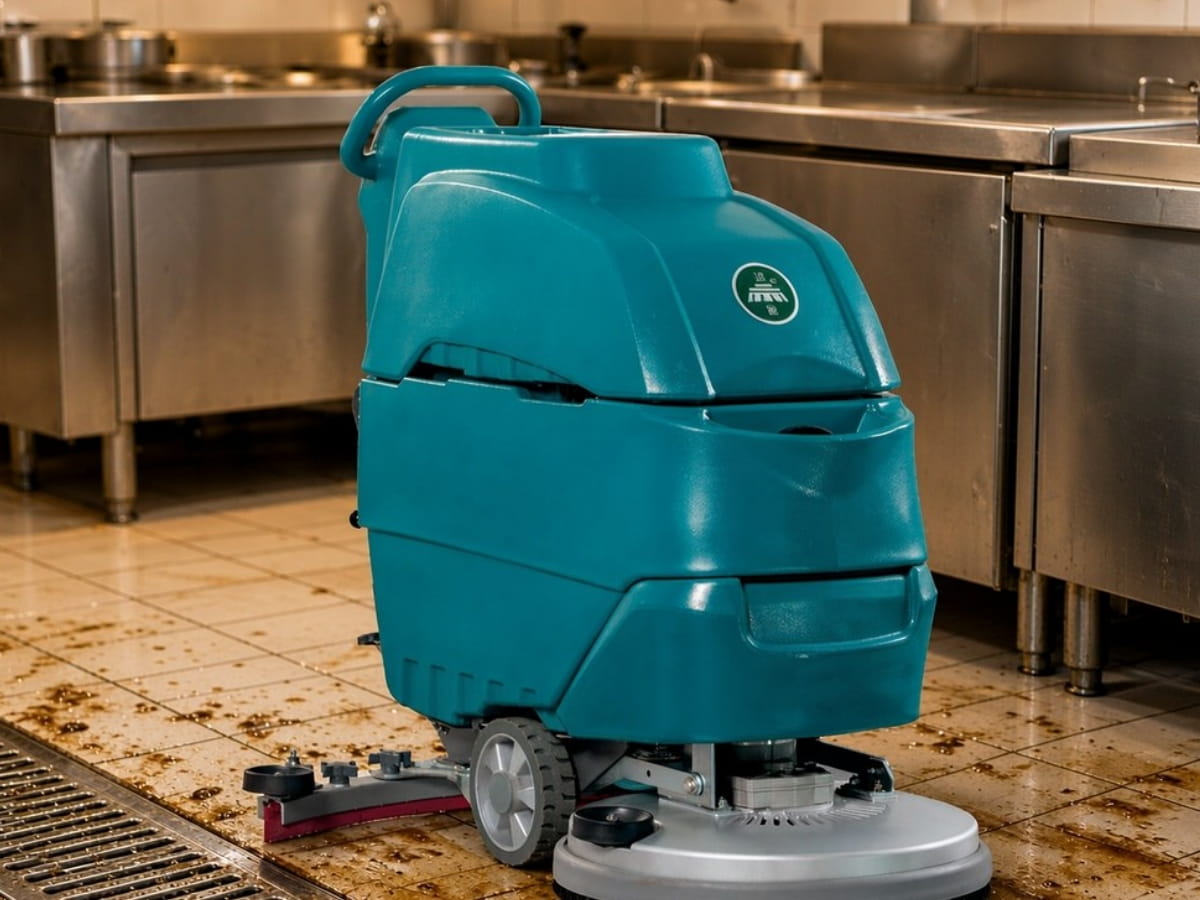
For hard-to-reach plant, a walk-behind scrubber such as the Jiechi BA680BT is a practical compromise. Its 530 mm brush path and 770 mm suction width reach between prep-room line legs a ride-on cannot, and the 2200 m²/h rated output lets one operator cover the medium-care block in a shift. The 68 L clean and 70 L recovery tanks keep most prep rooms going without a refill.
The interface that catches plants out is the door between zones, and it is where sanitation zone cleaning quietly fails: a machine coming from a low-care store into a high-care room carries wheels, brushes and squeegee edges loaded with the previous floor. Either assign a machine per block, or make a wheels-and-blades clean at the boundary a signed task.
Equipment materials for food environments
A scrubber in a food plant lives harder than in a supermarket: bumped into steel legs, washed with caustic, left in a damp store, expected to start at 5 a.m. Body and tank build decide whether it lasts three years or eight. Moulded tanks survive knocks better than steel panels that dent and hold water at the fold, and aluminium brush covers avoid the rust creep that starts on painted steel at the first chip. Wear parts should come off without tools: an operator who needs a spanner to change a squeegee blade will run a streaking one all week.
Check the openings too. A wide lid and smooth interior drain completely; ribs and a narrow outlet leave a film that is a contamination point by Friday. And check the machine comes apart round the brush deck, because what sits under the guard is what the auditor asks to see. On power, a lithium pack can be opportunity-charged between zones; sealed lead-acid is cheaper where an overnight window exists.
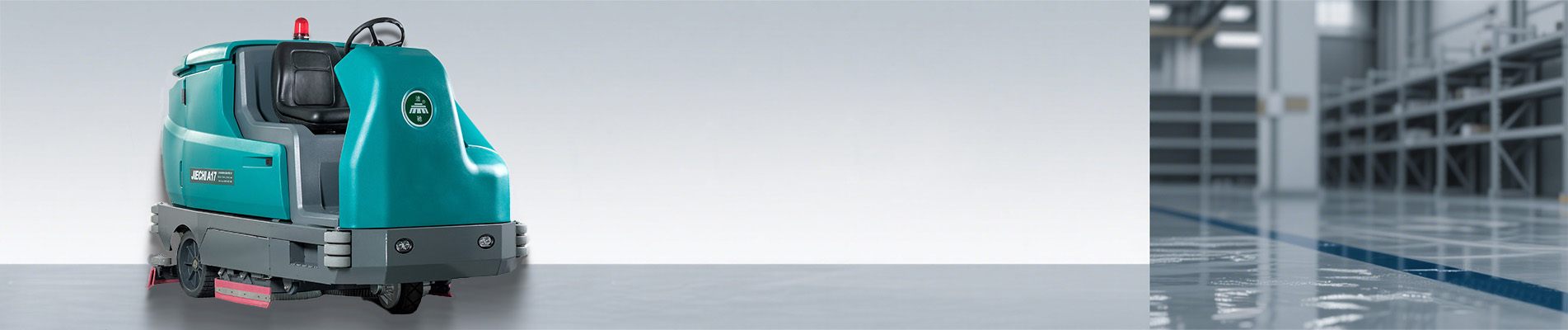
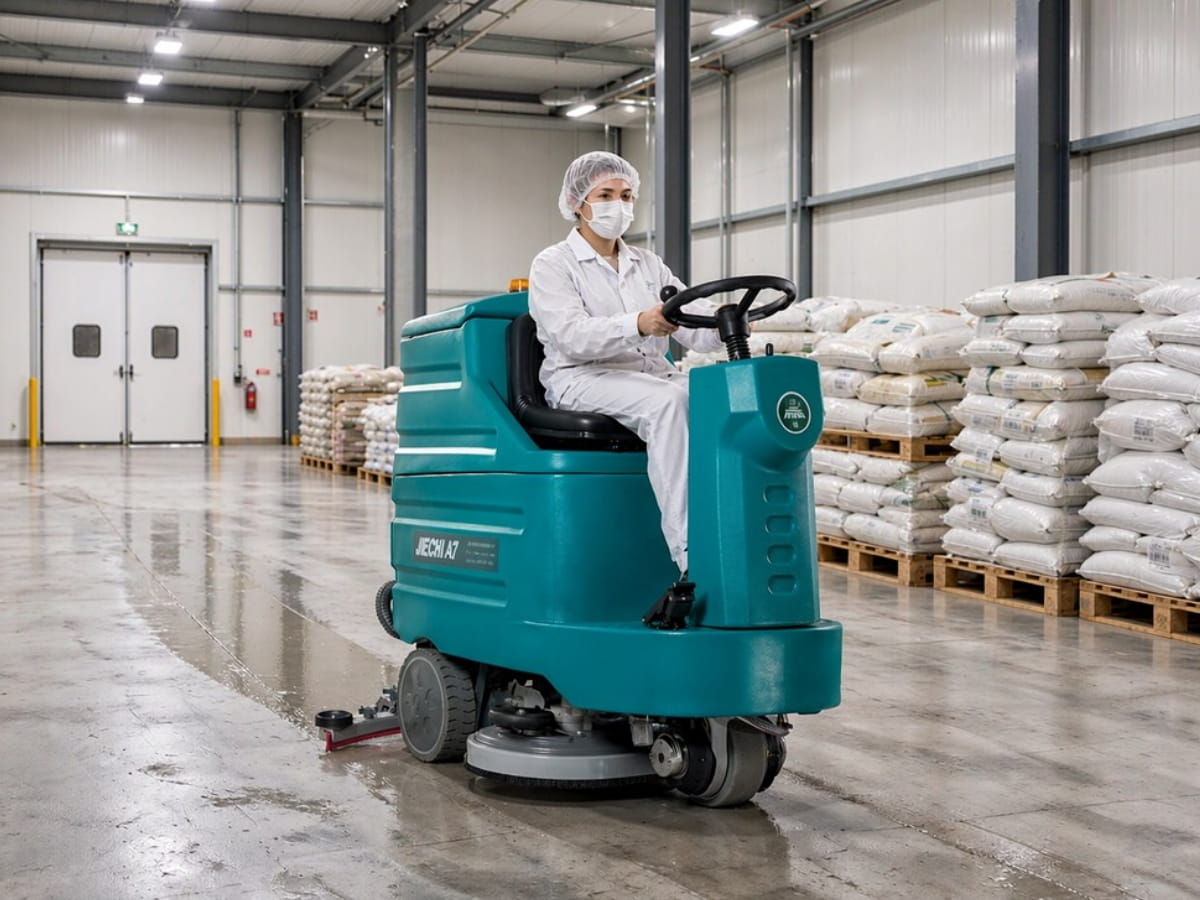
For wide corridors and cold stores, a ride-on covers ground far faster. A dual-brush ride-on scrubber like the Jiechi A7 runs an 860 mm brush path and a 1,100 mm squeegee at a rated 5500 m²/h, with 140 L clean and 150 L recovery tanks. The turning circle matters more than the width in a food building: it turns on the spot at the end of a narrow aisle instead of reversing into a racking leg.
From the field: spec the machine to the zone, not the plant
Jiechi has built cleaning equipment since 2003 across two production bases totalling 60,000 m². The most common mistake in food projects is one wide machine bought for the whole building: it will not fit between prep-room line legs, so the high-care rooms go back to mopping. Our usual answer is one compact walk-behind per high-care block, one ride-on for corridors and cold stores, and colour-coded squeegee blades at the store.
FAQ
Can I use one scrubber across all zones?
Mechanically yes, hygienically no. Wheels, brushes and squeegee edges carry soil room to room, so a shared machine needs a documented clean at every boundary. A unit per high-care block is usually cheaper than that compliance work.
Do we need a ride-on at all?
Only if you have the area. Corridors and dry stores above roughly 3,000 m² pay back a ride-on quickly. Below that, a walk-behind wins because it spends less time turning.
Match a machine to your zone map
Send us your zone layout and floor areas. We will recommend the walk-behind and ride-on split that fits each area
Tel: +1 2403149021 | Email: kliu@jiechi.com

 Phone: +1 2403149021
 Mail: kliu@jiechi.com



 Phone:+1 2403149021
 Email:kliu@jiechi.com



 English


