A7 vs M20 : Same Footprint, Scrubber or Sweeper-Scrubber?
Nov 03, 2026
Most buyers compare the Jiechi A7 and the M20 the same way they compare anything else: price on one side, cleaning width on the other. Both numbers mislead you here. The A7 — a dual-brush ride-on floor scrubber — is not the cheap option, and the sweeper-scrubber combination machine is not the wide one. They are the same machine with one component added, and that component decides whether your floor gets worked once or twice.
Below: the three real spec differences, what the hopper picks up and jams on, how throughput changes with debris on the floor, and a ten-minute test you can run tonight.
Quick Answer
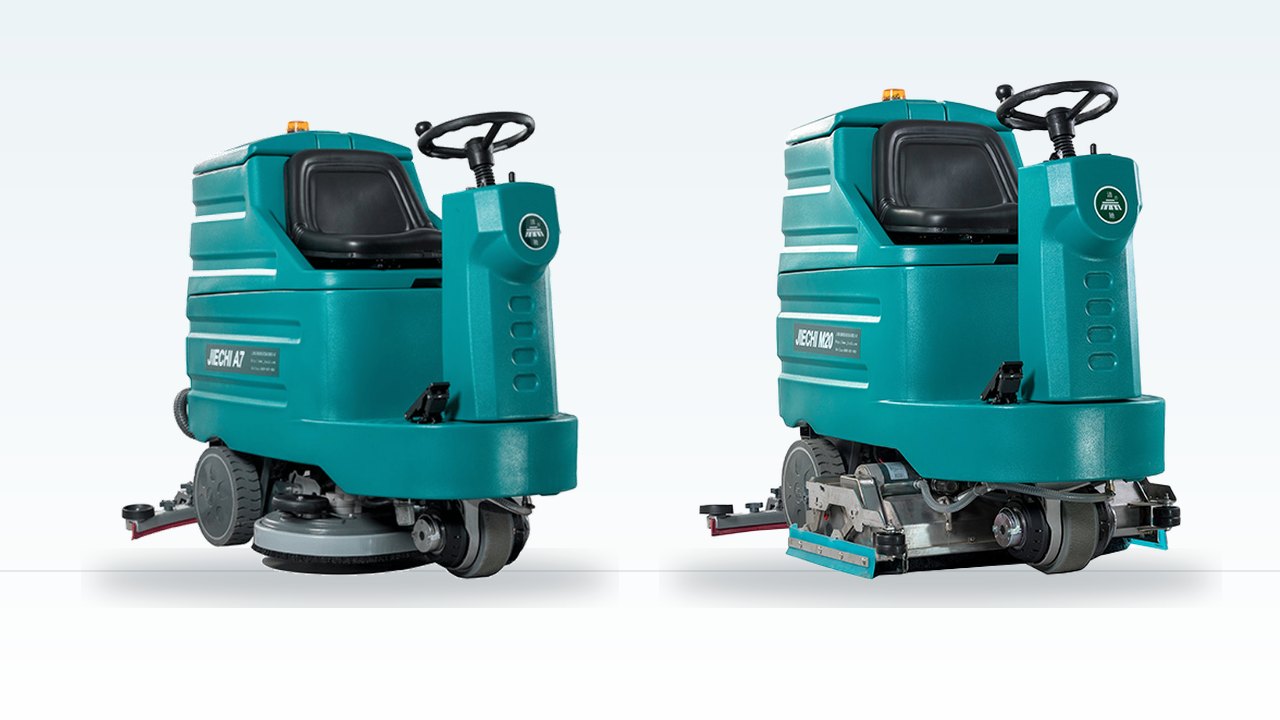
The A7 and the M20 share the same chassis, battery, brush motors and 5,500 m²/h rating, so either one fits the same site survey. The only real choice is whether you need the M20's 20 L front hopper. If dry, loose debris lands on your floor every shift — cardboard dust, stretch wrap, grit, wood chips — the M20 sweeps it up before scrubbing and removes an entire pass from your routine. If your floor stays dry-clean or is wet by nature, buy the A7 and keep 10 L more water capacity.
Key Takeaways
Identical 165 × 90 × 130 cm chassis, 330 kg, 24 V / 200 Ah battery, 560 W × 2 motors, 5,500 m²/h rated — every site constraint (doors, lifts, ramps, charging bay) applies equally to both.
Three real differences: the M20's deck is 40 mm wider, its tanks hold 10 L less each, and it carries the 20 L debris hopper.
The hopper's value is pass removal, not width: on a debris floor the A7 needs a sweep pass and a scrub pass, while the M20 finishes in one.
On normal warehousing debris the bin is emptied far less often than the tank is refilled — the hopper rarely becomes the machine's limiting cycle.
The hopper cannot be retrofitted onto an A7 later, so decide before you buy, not after the first season of complaints.
Table of Contents
One chassis, 165 × 90 × 130 cm, 330 kg: what actually differs
The 20 L debris hopper and what it really picks up
Throughput on a clean floor vs a debris floor
Water and hopper stops: two cycles instead of one
Which floor type makes the decision for you
One chassis, 165 × 90 × 130 cm, 330 kg: what actually differs
Here are the numbers from both datasheets, side by side. Read the last five rows first — they are identical, and that is the point.
Specification
A7 — scrubber
M20 — sweeper-scrubber
Brush deck width
860 mm
900 mm
Solution / recovery tanks
140 L / 150 L
130 L / 140 L
Debris hopper
—
20 L
Rated coverage
5,500 m²/h
5,500 m²/h
Battery
24 V / 200 Ah
24 V / 200 Ah
Brush motors
560 W × 2
560 W × 2
Machine weight
330 kg
330 kg
L × W × H
165 × 90 × 130 cm
165 × 90 × 130 cm
Same chassis, same battery, same rated output. The M20 adds a sweeping roller and a 20 L bin ahead of the brush deck.
Three differences, no more: a brush deck 40 mm wider, tanks 10 L smaller, and a 20 L hopper. Everything the site survey hinges on — doors, lifts, ramps, charging bay, mezzanine load limit — is unchanged, and a 90 cm doorway rules out both in exactly the same way.
The parts picture is almost as tight: brushes, pads and squeegee blades sit in the same deck family, so a storeroom stocking for one largely covers the other. The hopper assembly — roller, bin, filter — is the only stock the M20 adds. That matters at negotiation time too: the supplier's cost difference is one component, not a machine class, so ask for itemised quotes.
The 20 L debris hopper and what it really picks up
The hopper sits ahead of the brush deck. A roller lifts loose material into a 20 L bin, and only then does the deck lay down solution and scrub. That order matters more than the capacity number, because it means debris leaves the floor dry, as debris, instead of being wetted, crushed and smeared into a slurry your squeegee then has to chase.
The hopper's home turf: dry, loose material that a sweeping roller can lift before the deck ever touches it.
What goes in and what does not is the honest part of the decision, so here it is without marketing:
Debris on your floor
20 L hopper
Note
Cardboard dust, paper, cores
Picks up
The main warehouse case
Stretch film, pallet wrap
Picks up
Light film can tangle; clear it before it balls up
Wood splinters, pallet chips
Picks up
Up to roughly 30 mm
Entrance grit, small gravel
Picks up
The reason retail floors stay scratch-free
Wet leaves, mud, caked soil
Partial
Sticks to the bin; needs a manual clear
Standing water, oil, slurry
No
That is the deck's job, and both models do it
String, cable, twine, wire
No
Wraps the roller — the one real operating risk
Fine sand under 1 mm
Partial
Needs a slower pass, do not run at full speed
Read that table against your own floor and the decision usually becomes obvious. Dry and loose most of the time, and the hopper works every shift; wet by nature — a washdown area, a bottling line — and it sits empty.
In textile, packaging and cable operations the roller will pick up strapping within minutes — that is what a sweeping roller does, not a defect. Plan a two-minute check at every water stop.
Throughput on a clean floor vs a debris floor
Both machines are rated at 5,500 m²/h. On a clean, sealed floor that rating is the whole story: same speed, same deck class, same result — and paying extra for sweeping capacity you never use buys nothing.
On a debris floor the rating stops meaning the same thing, because the A7 now needs two passes. Either a second operator takes a walk-behind sweeper ahead of it, or the scrubber pushes debris into a wet strip the squeegee drags along. Whichever way you arrange it, the work happens twice.
One visit or two: the debris that forces the A7 into a second pass is gone before the M20's deck touches the floor.
Across a shift, the debris row is the only one that matters: the M20 finishes in one pass what the A7 finishes in two. Even when a walk-behind sweeper handles the pre-sweep, its pace is slower than a ride-on's, so the gap narrows but never closes.
Debris problems are rarely solved by buying a wider scrubber — a 1,060 mm deck still needs the debris gone first. Width buys speed on clean floors; only the hopper removes the pass.
Water and hopper stops: two cycles instead of one
Now the cost side, and it is smaller than the throughput gain. Because the hopper occupies volume inside the same envelope, the M20 carries 10 L less solution and recovery water — slightly shorter runs between refills, usually the only operating penalty of the combination.
In practice, on normal warehousing debris the bin is emptied far less often than the tank is refilled, so the M20 does not add a stop to your shift — you empty the bin while you refill the tank, one stop doing two jobs. On a genuinely filthy floor the rhythm can flip. That is not a reason to reject the machine — just check the bin rhythm in week one, not month three.
Which floor type makes the decision for you
Most buyers do not choose on economics — they choose on what is on the floor at 7 a.m. Match your situation to the row below and the answer is usually settled before the quote arrives.
Your floor
Buy
Why
Sealed concrete warehouse, cardboard dust, wrap
M20
The debris is the whole problem, not the floor
Food plant, washdown area, wet slurry only
A7
Nothing dry to pick up; keep the 140 L
Supermarket or mall, entrance grit and paper
M20
Grit at the doors scratches the finish
Showroom, polished floor, dust only
A7
A dust mop handles the dry work for less
Mixed multi-tenant industrial park
M20
You cannot control what tenants drop
Textile, packaging, cable operations
A7 plus manual sweep
String wraps any sweeping roller
Cold store below −10 °C
Neither
Battery and ice behaviour differ — spec separately
If you are still undecided, run a ten-minute test that settles it better than any brochure. Mark three 2 × 2 m squares — one at your busiest doorway, one mid-aisle, one where your worst mess happens. Sweep each into a dustpan and look at what you collect. Dry and loose in two of three, and the hopper earns its premium; sticky, wet or greasy in two of three, and the A7 is the better machine for the money.
Whichever way the test goes, specify both machines the same way: brush type matched to your floor finish, squeegee blade material matched to your chemistry, spares quoted with the machine rather than after the first failure. Those details move lifetime cost more than the model choice.
If your aisles are tighter than a ride-on allows, the walk-behind M16 combination machine does the same sweep-then-scrub job in a smaller footprint — the same logic, half the turning circle.
Common Questions
How much more does the M20 cost than the A7?
The M20 adds a sweeping roller, a 20 L bin and a filter to an identical chassis, so the price gap should reflect that hardware, not a different machine class. Ask for both quotes itemised so the hopper appears as its own line — a premium with no breakdown deserves an explanation before you sign.
Can I add a sweeping hopper to an A7 later?
No. The hopper is built into the chassis ahead of the deck, with its own drive and bin, so it is not a bolt-on accessory. If debris is likely to become a problem within two years, decide now rather than buying twice.
Will a 20 L hopper keep up with a large warehouse?
On normal warehousing debris, yes: the bin fills far less often than the tank empties, so it is rarely the limiting cycle. On heavily loaded floors it fills faster — check it at every refill during week one.
Does the M20 clean a wet floor as well as the A7?
Yes. Both run twin 560 W brush motors on the same deck family, with a 900 mm deck on the M20 against 860 mm on the A7. The only wet-side difference is 10 L less solution and recovery capacity, which shortens the refill cycle slightly.
Why does the M20 carry 10 L less water?
The hopper and its bin occupy volume inside the same 165 × 90 × 130 cm envelope, and nothing was added to compensate, so the tanks gave up 10 L each — a deliberate trade for a shorter water cycle.
Can one machine cover both a warehouse and the office area?
It can, if office flooring is hard and sealed — though it will not replace a carpet extractor, and the hopper is unnecessary there. If offices make up more than a third of the total area, a smaller walk-behind alongside often costs less to run than forcing one machine to do both.
Conclusion
The A7 and the M20 are one machine and one component. Judge them on a single question: is there dry, loose debris on your floor every day?
If yes, the 20 L hopper removes an entire pass and roughly doubles the floor you finish per shift on debris days. Ten litres of water is a fair price for that.
If no, buy the A7 and keep the larger tank. The most common mistake here is not buying the wrong machine — it is paying for sweeping capacity that never gets used.
Not sure which one fits your floor?
Send us three photos of your floor and your daily cleaned area — we will reply with a written recommendation, even if the answer is neither machine.
Email: kliu@jiechi.com | Phone / WhatsApp: +1 240 314 9021
Contact us

 Phone: +1 2403149021
 Mail: kliu@jiechi.com



 Phone:+1 2403149021
 Email:kliu@jiechi.com



 English


