Escalator Cleaner Buying Guide: What an EL510 Escalator Cleaning Machine Can and Cannot Do
Nov 04, 2026
Escalator steps punish a cleaning budget quietly. The grooved treads pack solid with grit and the black ring that builds at every landing, and the only tool that reaches those grooves properly is a hand brush worked step by step. Escalator cleaners exist to end that routine, but they are easy to buy wrong: buyers who treat them as small floor scrubbers get surprised by what the brush never touches.
Below: what a step-cleaning machine actually cleans, the three machine classes, what a 510 mm / 770 mm machine handles, where it stops working, how to build a steps-per-hour figure, and the checklist to run before you sign.
Quick Answer
An escalator cleaner mounts the running escalator, locks onto a step and travels with it, scrubbing tread and riser with a purpose-built brush — wet or dry — and vacuuming the slurry into its own tank. The escalator keeps running the whole time: no shutdown, no lost service. A current EL510-class machine runs a 510 mm main brush behind a 770 mm suction width, a 900 W brush motor at 435 rpm, a 2,400 W vacuum and an 800 W traction motor, with 50 L of solution and 55 L of recovery on a 140 kg frame — water feed, scrubbing and suction-drying combined in a single pass, and an automatic guidance system that fits every escalator type. It cleans steps and nothing else: handrail, glass, comb plates and the structure below need separate methods.
Key Takeaways
Judge it as a step machine, not a small floor scrubber: an automatic guidance system fits it to every escalator type, it locks onto the step and rides the running escalator — no shutdown needed, the escalator stays in service.
The datasheet numbers that matter: 510 mm main brush, 770 mm suction width, 900 W brush motor at 435 rpm, 2,400 W vacuum, 50 L / 55 L tanks, 140 kg, 125 × 59 × 109 cm.
Water feed, scrubbing and suction-drying run in one pass: wet mode is the periodic deep clean, dry mode is the faster maintenance pass.
Four things it never cleans: handrail, balustrade glass, comb plates, truss — scope them separately.
Put the confirmed figures in the tender in writing — 900 W brush motor, 435 rpm, 2,400 W vacuum, 50 / 55 L tanks — so the delivered machine matches the spec you ordered.
Throughput is a formula you fill in at a demonstration, not a brochure promise: steps per hour = 3,600 ÷ seconds per step cycle.
Table of Contents
What an escalator cleaner actually cleans
Machine classes: handheld, walk-behind and ride-on
What an EL510-class machine handles
Where escalator cleaners stop working
What an escalator cleaner actually cleans
Start with the surface, because everything about this class follows from it. An escalator step is not a floor: the tread is a comb of narrow metal cleats with a groove between each pair, the riser is a matching vertical face, and soil packs into those grooves under thousands of shoe soles a day. Mops ride over the top, and a brush shaped for flat slabs skips the profile entirely. A dedicated escalator cleaner carries a brush built for that profile: it locks positively onto the step — datasheets call it secure step engagement — digs into tread and riser grooves in one stroke, and recovers the slurry so the step can reopen dry.
The working surface: narrow cleats, deep grooves and a comb plate at the landing — geometry no flat-floor machine was shaped for.
The class runs two modes, and both belong in your routine. Wet mode resets a neglected escalator; dry mode skips the solution and clears the daily film faster. Both leave the same result: an empty groove instead of a black one. And notice what the description never claims — handrail, glass, comb plates and the structure under the steps sit outside the brush's reach.
Machine classes: handheld and walk-behind
You will meet three classes, and they are not interchangeable. Handheld step tools — brushes, grooved rollers, scrapers — are worked by an operator on foot. They cost little and they do reach the groove, but the result depends entirely on the person, the pace is slow, and the slurry ends up on the landing floor instead of in a tank. They suit one flight or a touch-up; they do not scale to a shopping centre.
Walk-behind indexed machines are the class this guide covers, typified by a compact wet/dry escalator cleaning machine. The operator walks beside it while the machine locks onto a step and travels with the moving escalator — cleaning happens in service, with no shutdown — turning escalator cleaning from a craft into a scheduled, repeatable shift task.
What an EL510-class machine handles
Here is the datasheet for the current class benchmark, read the way a buyer should read it — widths and power first.
Specification
EL510-class datasheet figure
Main brush width
510 mm
Suction width
770 mm
Brush motor
900 W
Brush rotation speed
435 rpm
Vacuum motor
2,400 W
Traction motor
800 W
Solution / recovery tanks
50 L / 55 L
Machine size (L × W × H)
125 × 59 × 109 cm
Machine weight
140 kg
Power supply
Mains, 220 V (confirm the delivered variant in writing)
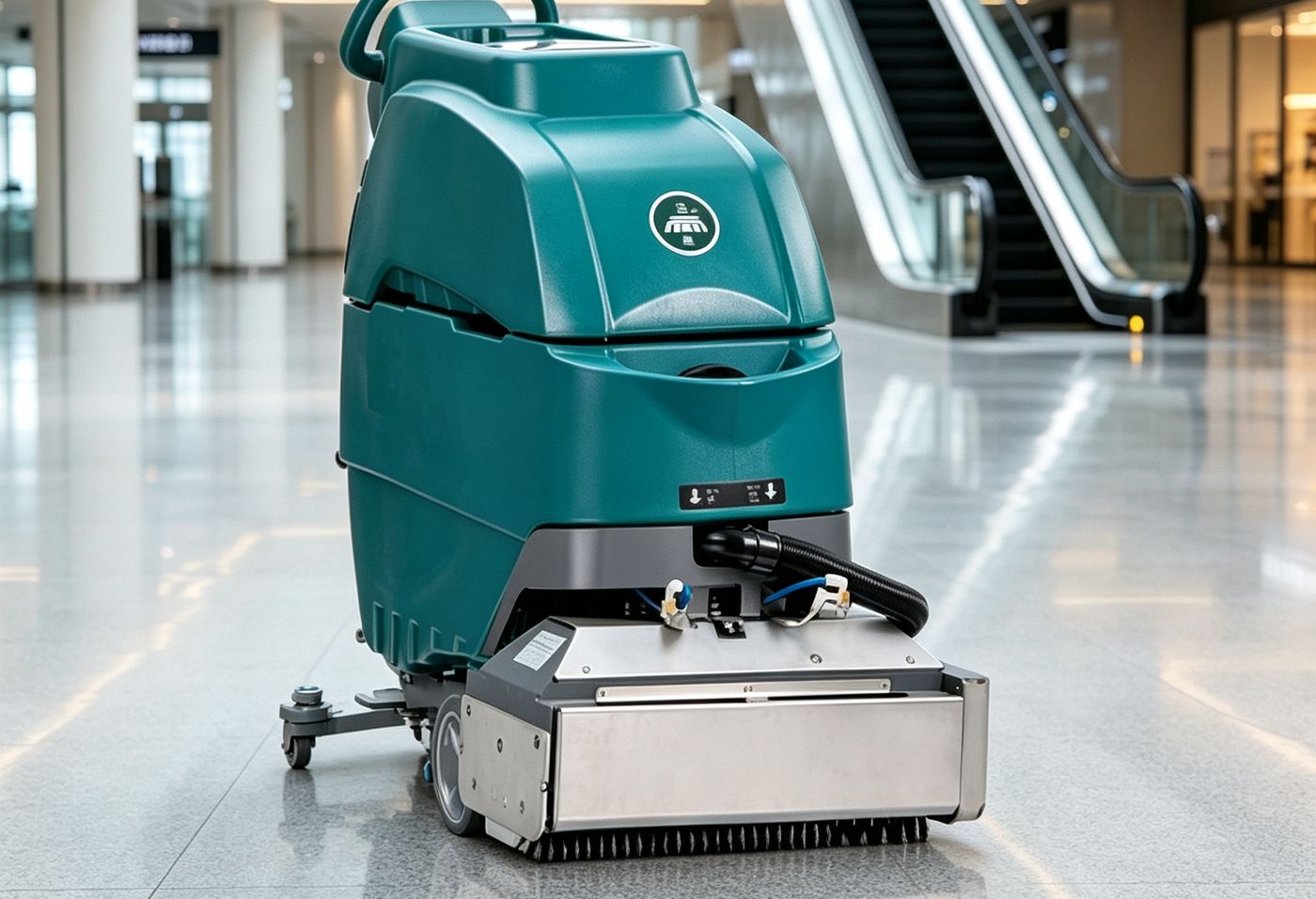
The class benchmark: a 510 mm brush deck under a recovery hood, 140 kg, sized to sit on a single escalator step.
Read the widths first. The 510 mm brush sits within the width of a standard commercial escalator step, so the tread face is covered without the frame fouling the skirting; wider steps take more than one pass, which your demonstration will show. The 770 mm suction width runs wider than the brush on purpose — it catches the mist the brush throws toward the skirting, keeping the glass and cladding clean while you work.
Then the power split. A 900 W brush motor turning at 435 rpm does the mechanical work in the grooves, with the water feed wetting the surface ahead of it and the 2,400 W vacuum pulling the slurry out behind — supply, scrub and suction-dry in a single pass. The vacuum is the larger number, and deliberately so: recovering slurry from a grooved surface is harder than laying water on a flat one. The 800 W traction motor drives the machine along the flight under control, and the automatic guidance system keeps it engaged with the steps as it adapts to each escalator type.
One design feature deserves a paragraph of its own: the automatic guidance system. It is the reason a single machine covers every escalator on your site — the guidance keeps the brush deck aligned with the step profile across all escalator types, so you are buying one tool for the whole estate rather than per-escalator tooling. Portability belongs in the same sentence: measure your lift car, the door widths and the tightest turn on the route before you order.
Where escalator cleaners stop working
The honest map of what a step machine covers is narrower than the escalator itself — draw the boundary before the quote, not after the delivery.
Green faces — treads and risers — are what a step machine cleans. The machine starts on the bottom step and rides the running escalator upward; the handrail, the glass, the comb plates and the structure below sit outside the brush.
The handrail comes first. It is a moving rubber loop, not a step, and it carries a film of skin oils that passengers notice faster than anything on the treads. Dedicated handrail machines and wipes exist for that surface; the step machine does not touch it.
The balustrade glass and cladding are a spray-and-squeegee job. The comb plates at both landings sit right where the machine starts and finishes, but the teeth and their recess are hand-detailing work with a small brush — the machine's brush deck does not fit them. The truss and pit below are a specialist contractor's territory.
The surrounding floors belong to floor machines, as the class section argued. And when a washdown leaves standing water on the landing, a slurry and flood pick-up wet vacuum keeps the area safe while the step machine works.
Common Questions
Does the escalator have to be shut down for cleaning?
No. The machine mounts the running escalator and travels with the steps, so cleaning fits inside opening hours — no shutdown and no lost service time. Barrier the landing where the machine starts and finishes so passengers keep clear of it.
Will it clean the handrail?
It will not — the handrail has its own equipment class, from dedicated handrail cleaning machines down to impregnated wipes for short loops. Put it in the same tender so both methods are scheduled together.
Wet or dry mode — when do I use each?
Wet mode resets packed grooves; dry mode maintains the result between deep cleans. The split is yours to set from traffic.
Will it fit through my building's lifts and corridors?
At 125 × 59 × 109 cm and 140 kg, most service lifts carry it — but paper dimensions have embarrassed better buyers than you. Walk the transport route with a tape measure first.
How often should escalator steps get a machine clean?
Traffic decides, not the calendar: a transit hub and a quiet office lobby will not share an answer. Set the first interval from appearance, then adjust from what the deep clean actually recovers.
Conclusion
An escalator cleaner is a step machine, full stop. The EL510-class numbers — a 510 mm brush, 770 mm of suction, 900 W of brush power at 435 rpm and a 2,400 W vacuum on a 140 kg frame — are built to reset treads and risers that hand tools reset slowly and floor machines reset never. An automatic guidance system fits it to every escalator type, water feed, scrubbing and suction-drying run in a single pass, and the escalator stays in service throughout. Its boundary is just as clear: handrail, glass, comb plates, truss and surrounding floors are other purchases.
Scope the whole escalator, time a cycle at a demonstration, and let the formula set your steps per hour.
Want a throughput figure for your own escalators?
Send us your step count, flights and traffic pattern — we will return a written cleaning-window estimate and the right machine class, even if it is not ours.
Email: kliu@jiechi.com | Phone / WhatsApp: +1 240 314 9021
Contact us

 Phone: +1 2403149021
 Mail: kliu@jiechi.com



 Phone:+1 2403149021
 Email:kliu@jiechi.com



 English


