ROI of Switching from Mopping to a Floor Scrubber: Worked Example
Oct 20, 2026
Quick Answer
The machine wins on hours, not on kit price. Budget manual mopping at roughly 5,000 sq ft per labour hour once bucket changes and edges are counted. Plan a 530 mm walk-behind at 12,000 to 13,000 sq ft per hour. On 40,000 sq ft cleaned nightly, that turns eight labour hours into about three and a half.
Baseline: what manual mopping really costs
Start where the mop actually is. A person wet mopping an open corridor covers ground quickly for about ten minutes, then slows: wring out, move the bucket, shift a chair, wait for the section to dry, redo the patch somebody walked across.
A genuine mop vs scrubber cost comparison counts every line: replacement mop heads, laundering where you use it, buckets and wringers, wet floor signs, detergent, two or three water changes a shift, and the minutes lost when a spill has to be boxed off and redone. Individually these are rounding errors. Across a year they are a budget line.
Nobody writes down consistency either. Hand pressure varies, dilution drifts, and by the fourth bucket the water is grey. The floor looks acceptable and tests badly, which is why complaints tend to arrive months before the cost review.
Effective rate: mop vs walk-behind vs ride-on
Rated coverage assumes clean, straight runs. Model against an effective rate, which is what your team delivers when the aisles are half full.
Method
Working path
Planning rate
Where it fits
Wet mop and bucket
About 0.5 m
400–500 m²/h (4,300–5,400 sq ft/h)
Small rooms, washrooms, spot work
Walk-behind scrubber
530-860 mm
1,500–4,200 m²/h (12,000–14,000 sq ft/h)
Retail aisles, clinics, schools
Ride-on scrubber
530–1060 mm
2,700–8,600 m²/h (21,000–30,000 sq ft/h)
Open halls, logistics
Those planning rates drive most labour savings floor cleaning models, which is why timing your own shift beats quoting someone else's figure. Rate also matters less than fit: a machine that cannot turn in your tightest aisle gives back every minute it wins down the long one.
Redeployed hours vs reduced hours - the honest distinction
This is where most cases lose their audience. Hours freed by a machine do not all convert to cash. Some become detail work you were quietly skipping: edges, door tracks, and spill response nobody formally owned.
Split them into two lines. Reduced hours leave the payroll, redeployed hours improve the building. Put both in the table, because finance will find the difference if you do not.
A mechanised cleaning ROI figure should rest on the reduced column alone. Redeployed hours have value, but it is a quality argument, and blending the two is how a credibility problem starts.
Then apply your own labour rules. Minimum shift lengths, collective agreements and part-time contracts all decide how many hours can genuinely come off. Two hours saved nightly means little to someone on a three-hour minimum.
Worked 3-year example for a 50,000 sq ft site
Take a 50,000 sq ft site cleaned five nights a week. Not every square foot gets mopped, so it is the cleanable hard floor that matters. Every input below is a placeholder; swap in yours and the table recalculates.
Input
Value used
Where to get your own
Cleanable hard floor
40,000 sq ft (3,700 m²)
Drawings minus fixtures, racking and carpet
Frequency
260 nights per year
Current cleaning schedule
Manual effective rate
450 m²/h
Time one full shift
Scrubber planning rate
1,200 m²/h plus 0.4 h detail
Path width times walking pace
Fully loaded labour rate
$22 per hour
Payroll plus on-costs
The arithmetic is short. Mopping takes 3,700 ÷ 450, about 8.2 hours a night. Scrubbing takes 3,700 ÷ 1,200, about 3.1 hours, plus 0.4 for edges: call it 3.5. That frees 4.7 hours a night. Assume 2.7 of those leave the payroll and 2.0 move into detail work that was not happening.
Line
Year 1
Year 2
Year 3
Payroll hours removed
702
702
702
Labour value at $22/h
$15,444
$15,444
$15,444
Machine amortised over five years ($7,500)
−$1,500
−$1,500
−$1,500
Pads, brushes, squeegee blades, service
−$1,200
−$1,200
−$1,200
Detergent, water and charging
−$500
−$500
−$500
Purchase price, one-off
−$7,500
—
—
Net cash effect
$4,744
$12,244
$12,244
Three-year total of about $29,200 against a $7,500 machine, so payback lands inside year one. Add roughly 520 hours a year of detail work now getting done, worth $11,400 at the same rate if you were otherwise paying for it.
The shape matters more than the numbers. Move the labour rate and the result moves in a straight line; move the planning rate and it moves faster, because coverage drives every other line. A model that survives only when everything goes right does not survive.
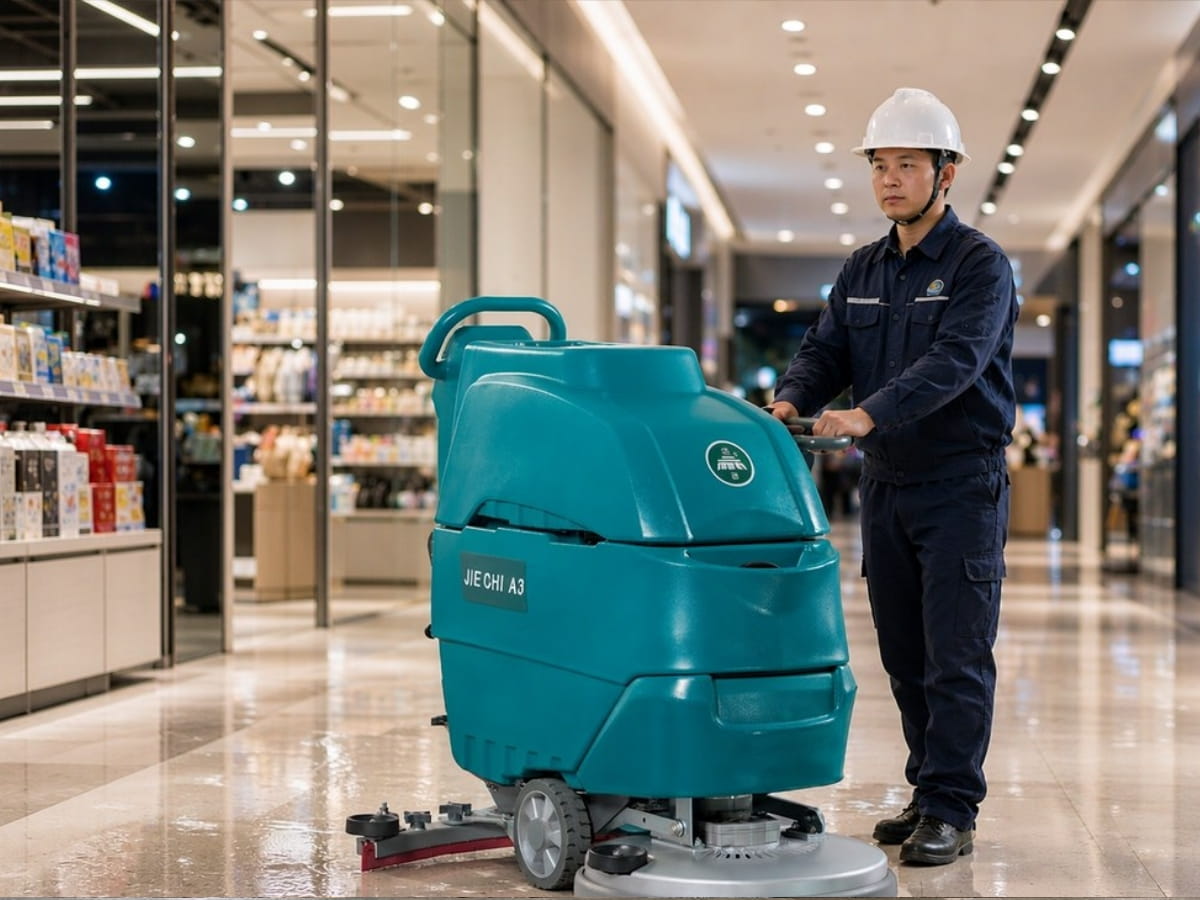
Size the machine to the floor first. A walk-behind scrubber like the Jiechi A3 works a 530 mm brush path behind a 770 mm squeegee, carries 50 L solution and 55 L recovery, and rates 2,200 m²/h. At 155 kg it is light enough for one person to unload and heavy enough to track straight down an aisle.
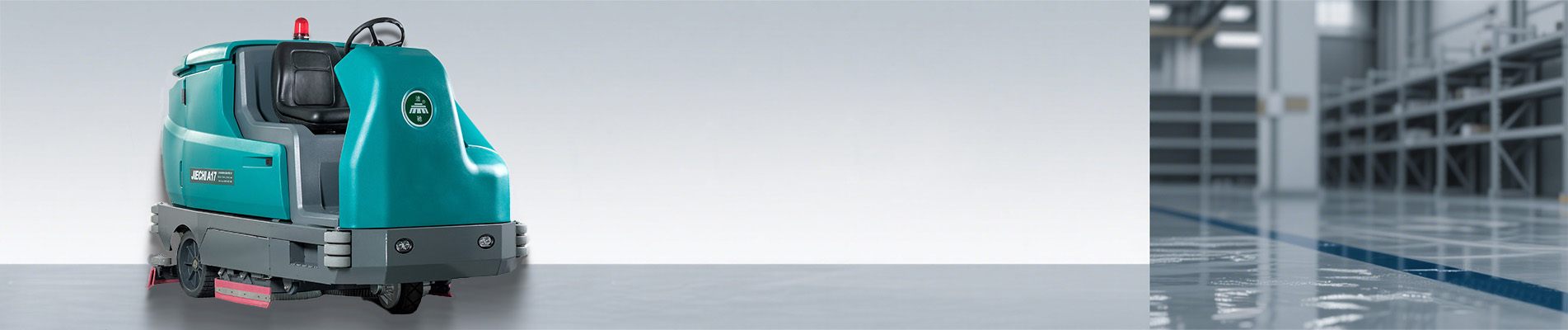
Where the same area is split into rooms rather than long aisles, the operator should be sitting down. The Jiechi A5 keeps a 530 mm path on a 126 cm body, rates 2,700 m²/h, carries 65 L and 75 L, and turns inside a lift lobby without a second person spotting.
Quality and safety gains that do not show in the maths
Some of the value never reaches a spreadsheet, and it is usually what gets the decision over the line.
Gain
What it protects
Floor left almost dry behind the squeegee
Slip exposure during and after the shift
One detergent dilution all night
Floor finish and grout, plus fewer early strips
Repeatable result on every run
Audit scores and inspection outcomes
No wringer trolleys in public corridors
Customer experience and insurance questions
Less bending and wringing per shift
Staff retention on a hard-to-fill roster
None of this pays this month's wages. It stops money going out later: a claim, a floor stripped a year early, or a failed audit.
From the field: what we ask for before quoting
Jiechi has built floor cleaning machines since 2003 across two production bases totalling 60,000 m², and the enquiries that end in an order usually start with a timed shift rather than a price request. Send us the floor plan, the cleaning frequency and the night roster. We will run this same three-year table with your numbers and size the machine to it, even when that turns out smaller than the one you asked about.
What size of site makes the switch worthwhile?
Look at hours, not area. Once the nightly mop takes more than about four labour hours, a walk-behind usually pays for itself inside a year. Below that, it depends on your labour rate.
What usually gets missed in the budget?
Squeegee blades, brush and pad wear, a battery reserve after year three, and somewhere secure to charge and empty the machine.
Send us your floor plan and roster
Tell us the floor area, how often it is cleaned and how many hours it takes.
Tel: +1 2403149021 | Email: kliu@jiechi.com

 Phone: +1 2403149021
 Mail: kliu@jiechi.com



 Phone:+1 2403149021
 Email:kliu@jiechi.com



 English


