
 Phone: +1 2403149021
 Mail: kliu@jiechi.com
Phone: +1 2403149021Mail: kliu@jiechi.com


How to Deploy Cleaning Robots Safely in High-Traffic Public Spaces: Retail and Airports
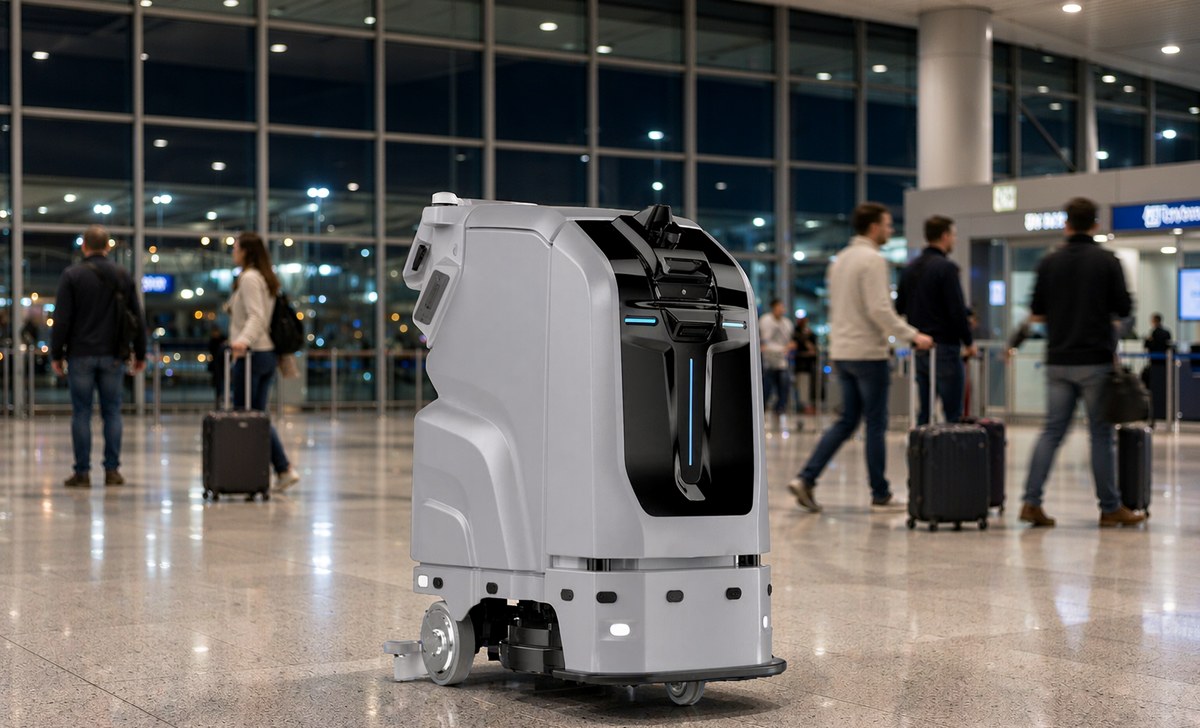
Cleaning robots in retail and airports work when three things are true at once: the area is mapped with its fixed obstacles marked, the route avoids peak footfall, and the dock handles charging plus water on its own.
Robotic cleaning public spaces is mostly a question of predictability. Warehouse layouts change weekly. A shopping concourse or a departure hall does not, and that is why these two building types sit at the front of every deployment list.
Cleaning robots in retail and airports are not a technology problem. They are a mapping problem, a route problem and a dock problem, in that order. Annotate the map, split routes by footfall, put the dock where the run ends, and report coverage plus interventions. Get those four right and the machine just becomes the thing that cleans the concourse.
Three conditions decide whether an autonomous machine pays for itself, and malls and terminals satisfy all three. The floor is large and open. The layout holds still for months. The task is identical every night: cover everything, leave it dry, finish before doors open.
Night shifts in public buildings are expensive and hard to staff, and the work is dull enough that turnover stays high. A machine that takes the open concourse leaves people on the jobs that need judgement.
Our JC80 autonomous scrubber is rated at 2,040 m² per hour, at 1.2 m/s with a 510 mm scrub path. Treat that as an upper bound. Real coverage depends on how much of the plan is open floor.
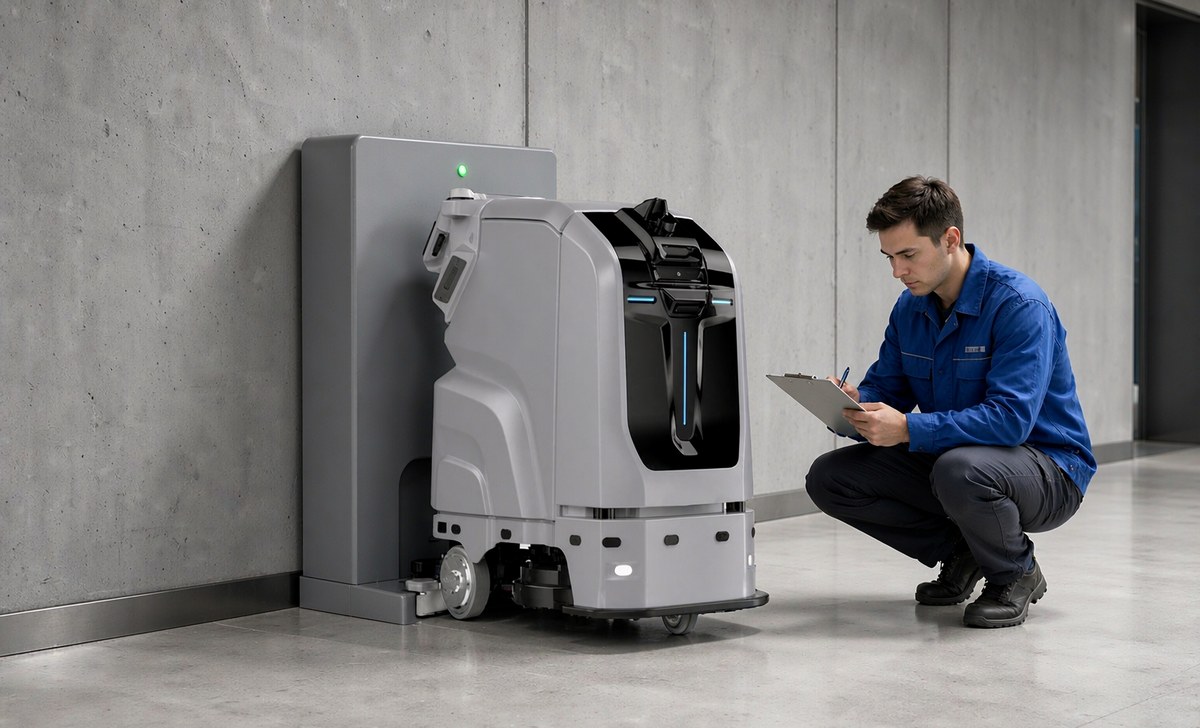
Cleaning robots retail airport deployments differ from warehouse ones in one respect: the public is in the same space and is not paying attention. People stop without warning, push trolleys into the path and walk backwards while looking at a phone.
The JC80 carries a fused sensor set for that. A panoramic monocular camera, LiDAR, a 3D ToF module, a single-line laser, an IMU, ultrasonic radar and a physical bumper strip. Reaction is quoted at 20 ms, with 2 cm recognition accuracy and a 210° forward field of view. It runs under 65 dB, which is why it can work a trading floor at all.
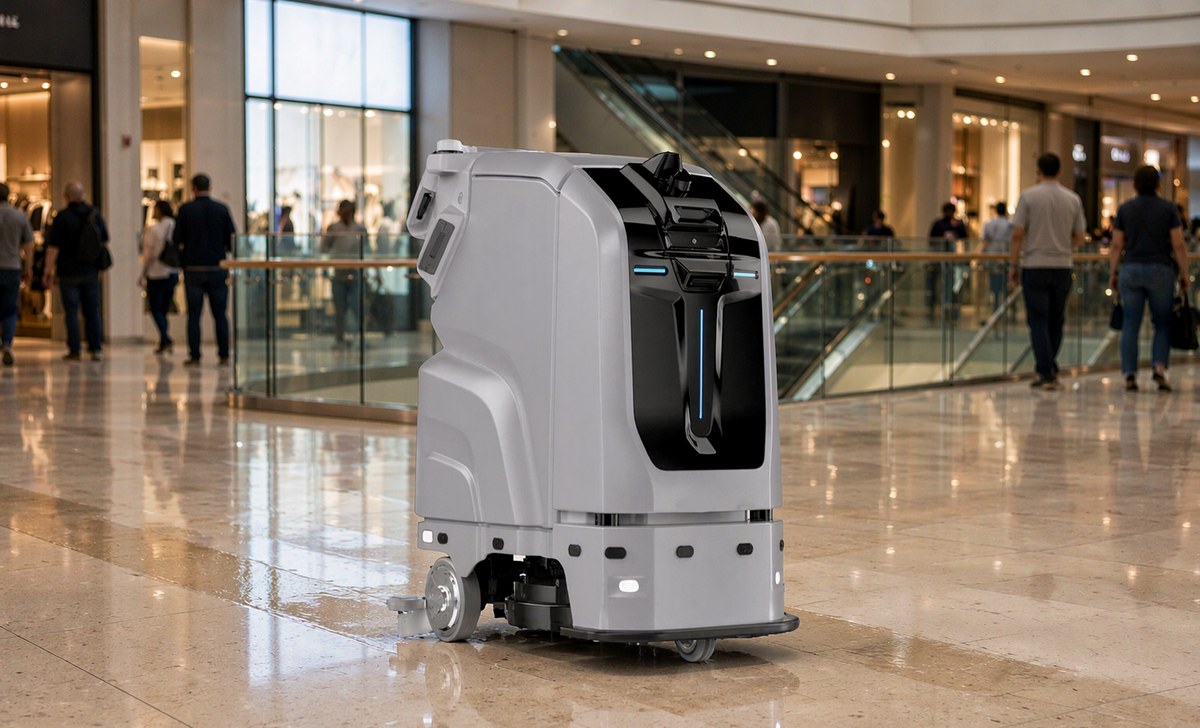
Sensors reduce risk but not remove it. Speed matters as much as sensing. A machine at 1.2 m/s through a lunchtime food court is a different proposition from the same machine in an empty hall at 05:00.
Map first, then edit. Raw mapping only draws the boundary; the useful work is the annotation layer on top. On the JC80 that means laser-shielded zones, floor material per area, boxed lift zones, speed bumps, and the road network the machine may use.
Then split the day. Autonomous scrubber mall projects that fail usually fail here, because one route was programmed and expected to work at 10:00 and at 22:00.
Off-peak. Full-width passes on the main concourse, full speed, dock cycle at the end. This is where the machine earns its keep.
Shoulder hours. Reduced speed, exclusion zones around seating that fills up, shorter windows.
Peak. Back-of-house corridors, or pause. A cleaning robot passenger terminal duty does not have to run on the passenger side to be worth having.
Narrow areas need a different machine. The JC10 compact cleaning robot is 350 mm wide, 52 × 42 × 49 cm and 26 kg, rated at 756 m²/h. It goes under benches and between gondola ends where a 510 mm unit will not fit.
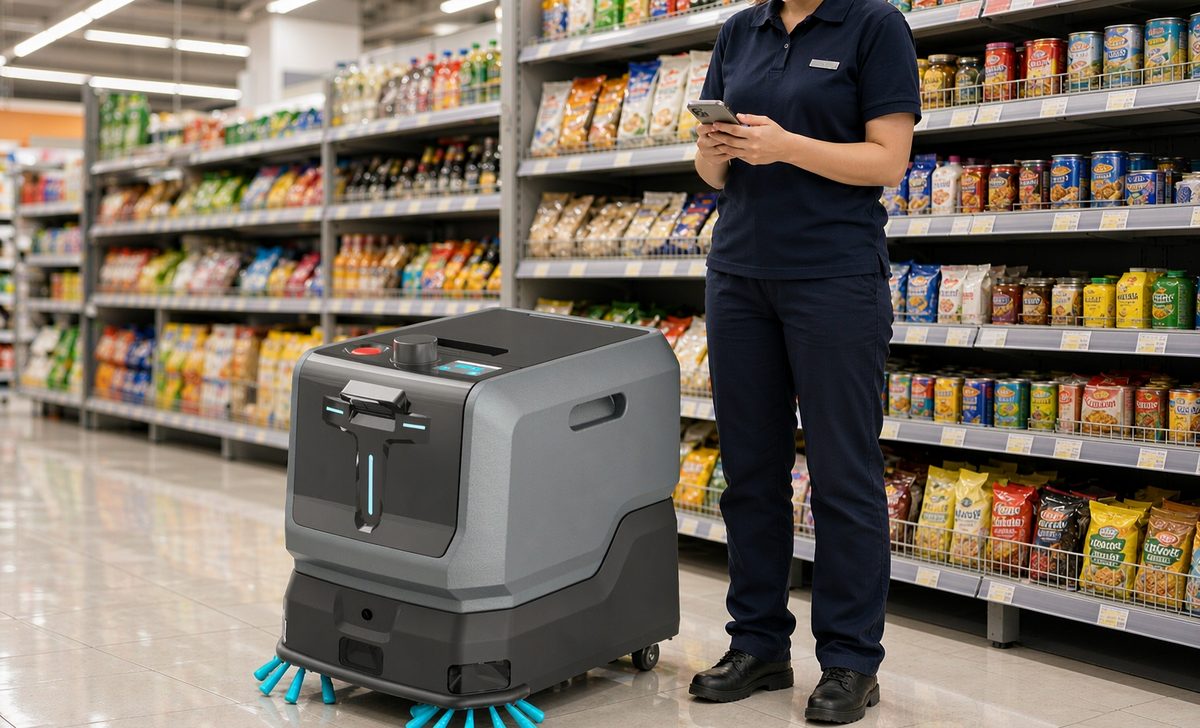
Two numbers set the rhythm: 70 L clean and 50 L recovery on the JC80, about 3.5 hours of scrubbing per charge. A full night shift therefore needs the machine to return to its dock. That only works if the task start point is the dock. Set it there and the machine returns when the task ends, taking charge and exchanging water by itself.
Dock placement has rules that get ignored in a hurry. Keep 2 m clear, keep reflective material out of that zone, and do not shift it more than about 20 cm laterally once deployed, or it has to be redeployed.
Squeegee rubber is the other recurring one. Clean it daily and the weekly checks take minutes. Leave it and streaking gets blamed on the machine.
A dashcam is fitted as standard and remote updates are supported, which helps when a site manager wants to see what happened rather than read a summary.
Are cleaning robots retail airport deployments harder than warehouse ones?
Yes, because the public is unpredictable. The hardware is the same; the difference is route design, speed limits and how much of the map you annotate first.
Can an autonomous scrubber run during trading hours?
Under 65 dB and at reduced speed, in areas with predictable footfall, yes. Most sites still run the main concourse out of hours and keep the robot on back-of-house corridors by day.
How much area does one robot cover in a night?
The JC80 is rated at 2,040 m² per hour with 3.5 hours of scrub run time per charge. Plan from your actual open floor area, then subtract turnarounds.
What happens if the run gets interrupted?
The JC80 stores its position and resumes from the break point. Task reports show the previous and next end times so you can see where it stopped.
Send us your floor plan, opening hours and the zone you want to start with. We will tell you which areas suit an autonomous unit, what to annotate, and where the dock should sit.
Tel: +1 2403149021 | Email: kliu@jiechi.com

 Phone:+1 2403149021
 Email:kliu@jiechi.com

leave a message
Scan To Wechat :

Scan To WhatsApp :

 English


