Scrubber-Sweeper Combination Machines: When One Machine Beats Two
Oct 08, 2026
Quick Answer Key Takeaways How It Works Two Passes Into One Site Conditions Payload & Shift Time Dual System Care Walk-behind vs Ride-on FAQ Conclusion Contact Us
Quick Answer
A scrubber sweeper combination machine sweeps dry debris into a hopper and scrubs the same strip of floor in one pass, so one operator replaces a two-machine, two-pass routine. It beats two machines when the floor carries both dust and stuck-on soil, and when the site is too small to justify a separate sweeper.
Key Takeaways
The hopper handles dry debris first, the brush deck and squeegee handle the wet work second, in the same travel direction.
The saving is mostly operator hours and scheduling, not water or detergent.
Mixed soil is the deciding factor. Floors with only dust suit a sweeper; floors with only film suit a scrubber.
Dual systems mean two service routines. Skipping the sweeping side is how these machines get a bad reputation.
The usual cleaning routine on a factory floor is two machines and two passes: a sweeper to get the grit up, then a scrubber once the loose material is gone. It works, and it costs two operators, two sets of consumables and a slot in the production calendar twice.
A combination machine collapses that into one pass. Whether that is a genuine improvement depends on the soil, the aisle layout and how much of the shift is spent on things other than cleaning. Here is how to tell.
How a combination machine works: sweeping then scrubbing
The sequence matters, and it runs front to back.
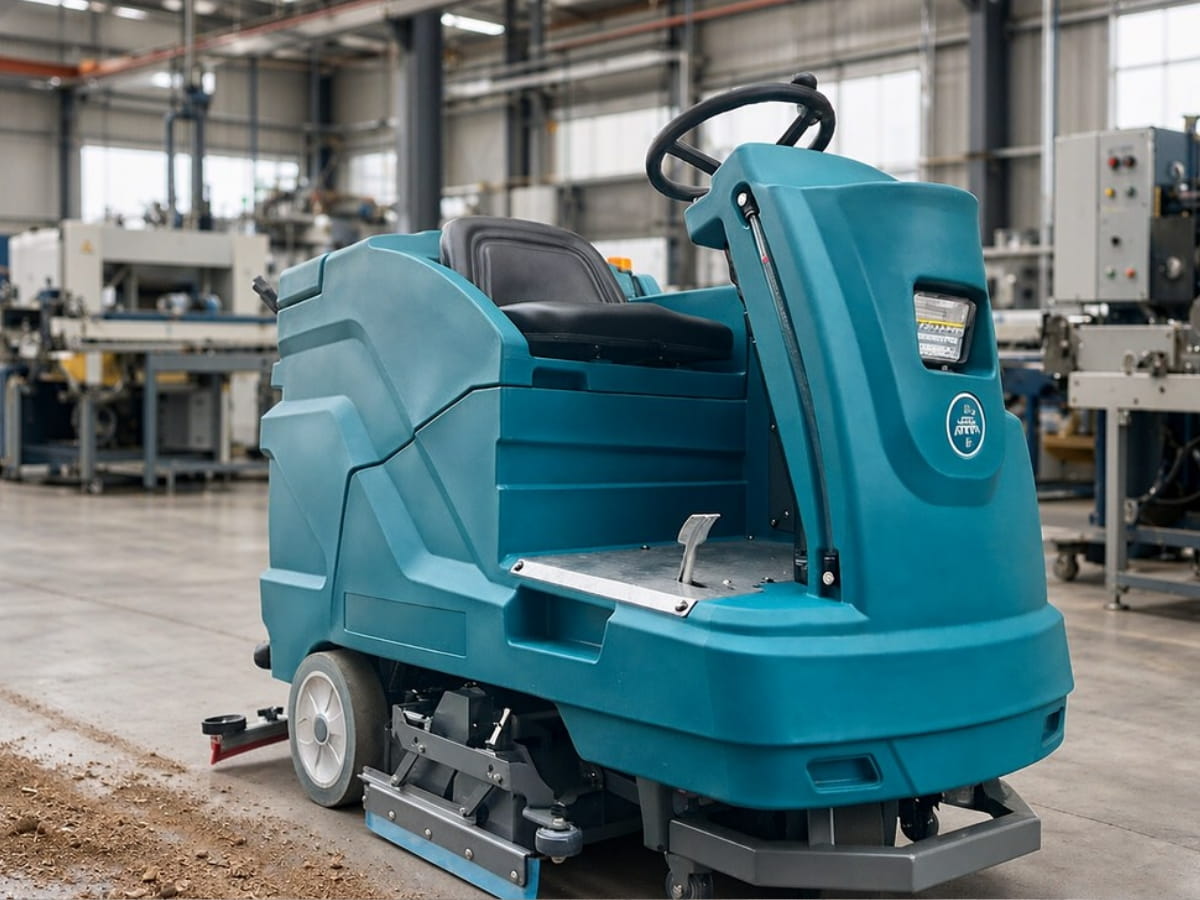
A cylindrical main brush lifts and throws. Unlike a disc brush that works flat against the floor, the roller brush on a combination unit turns against the direction of travel and flicks debris forward into a hopper. That is what lets it pick up a bolt or a wood offcut rather than pushing it around.
The hopper collects dry. Debris goes into a separate container, kept dry and separate from the recovery tank. This is the part that makes the single-pass idea work at all: if grit went into the wet system it would settle in the tank and shorten the life of the suction motor.
Solution goes down behind the debris pickup. With the loose material gone, the brush deck works on film and marks rather than grinding grit into the surface.
The squeegee recovers immediately. Same pass, same direction, floor left dry behind the machine. An all in one scrubber sweeper is not a compromise between the two jobs; it runs them in the correct order, one behind the other.
One practical limit worth knowing before you buy: the hopper handles debris up to a certain size, and beyond that the operator still needs a broom and a dustpan. Fine grit, sand, food residue, swarf and broken packaging are all inside the range. Pallet fragments and long offcuts are not.
Where two passes become one
The obvious saving is the second pass over the same floor. The real saving is usually somewhere else.
Scheduling. Two machines need two windows, and in a plant running two shifts those windows are the hard part. One machine needs one window, which is often the difference between cleaning daily and cleaning when there is space in the calendar.
Labour. One operator, one set of tank stops, one end-of-shift rinse. On a mid-size site that is commonly 60 to 90 minutes a day recovered.
Fleet count. A combination floor machine replaces two assets in the register. Fewer machines means fewer batteries to manage, one parts list and one service contract.
Site conditions that suit combinations
Use this table against your own floor before you decide. The pattern to look for is mixed soil, not heavy soil.
Site condition
Suits a combination?
Why
Dust plus tyre marks and spills
Strong fit
Both jobs are genuinely needed on every pass
Mixed debris, small metal swarf, packaging
Strong fit
Roller brush lifts what a disc brush would push
Fine dry dust only, no wet soil
Poor fit
The scrubbing half never earns its keep
Heavy liquid or thick sludge
Poor fit
The hopper is the wrong container for the volume
Very tight aisles under 1.2 m
Check the width
Combination decks are wider than a plain scrubber
Long unbroken runs over 5,000 m²
Ride-on class
Operator fatigue becomes the limit, not the machine
Payload, water capacity and shift time
A combination machine carries three things instead of two: solution, recovered water and dry debris. All three fill up, and whichever fills first ends the run.
On a walk-behind class unit that usually means a 95 L solution tank and 105 L recovery tank alongside a hopper of around 20 L. The hopper is the one that surprises people, because on a floor with genuine debris it fills long before the water does. Empty the hopper when it is a third full rather than waiting; a full hopper stops lifting and the main brush starts redepositing.
From the field: what one ride-on covers in a shift
The JIECHI M10 is published at 6,000 m²/h with a 280 L solution tank, 300 L recovery tank and 36V/220Ah. At a realistic 60% of that rate, four hours of running moves roughly 14,000 m² before tank stops. That is a planning figure from published specifications, not a measured result.
Work backwards from the shift rather than forwards from the spec sheet. Decide how many hours the floor is available, subtract tank stops and hopper stops, and check the remaining time still covers the area. If it does not, the answer is a bigger machine, not a faster operator.
It also helps to know where the water actually goes. Recovery capacity should be at least as large as solution capacity, because detergent, soil and the rinse water from the previous shift all add volume. A machine with a solution tank larger than its recovery tank will stop sooner than the spec sheet suggests.
Maintenance of dual systems
Empty and clean the hopper every shift. Left overnight, damp debris compacts and the following day the brush carries it instead of lifting it. Check the hopper seal at the same time.
Inspect the roller brush for wrapped material. Strapping, film and wire bind around the cylinder and flatten the bristles in one section. It takes a minute to cut away and it changes how the machine picks up.
Keep the squeegee and recovery side separate in your head. Blades, filters and the recovery tank need the same attention as on any scrubber. Treating the machine as a sweeper with a tank bolted on is the common failure.
Watch brush pressure. Combination units run the main brush at a set pressure range, and worn bristles change what the machine does to the floor. Set it to the published range rather than guessing.
Walk-behind vs ride-on combination classes
Both classes exist for a reason, and the choice is mostly about area and aisle geometry rather than budget.
Walk-behind suits up to roughly 4,000 m² per shift. It turns in tighter spaces, needs less storage, and one operator can load it into a van. An M series cleaning machine in this class, such as the JIECHI M16, carries 24V/200Ah, an 860 mm path, 4,200 m²/h and a 20 L hopper, which is the configuration that fits a small or mid-size plant with mixed debris.
Ride-on suits long runs and continuous shifts. Above about 5,000 m² per shift, operator fatigue becomes the limiting factor, and a seated machine with a large tank set runs longer between stops. The trade-off is turning radius and machine weight, so check the tightest corner the route includes.
If the site has both conditions, a long main hall and a tight packing area, the honest answer is often one of each rather than one machine trying to do both. Splitting the fleet also protects the schedule: when one unit is in for service, the floor still gets cleaned.
Whichever class you land on, ask the supplier for the cleaning width. The width decides how long the job takes.
Frequently Asked Questions
Can a combination machine replace a sweeper and a scrubber entirely?
On mixed-soil floors, yes for day-to-day work. Sites with heavy fine dust or heavy liquid usually still keep a dedicated machine for those areas.
Does one pass clean as well as two?
For typical factory soil, yes. The order is the same as a two-machine routine: dry debris up first, then solution, then recovery.
What fills first, the hopper or the tanks?
Usually the hopper on any floor with real debris. Empty it at a third full so the main brush keeps lifting.
How much area suits a walk-behind combination?
Up to roughly 4,000 m² per shift. Beyond that, operator fatigue makes a ride-on the better answer.
Conclusion
A scrubber sweeper combination machine wins when the floor carries dust and stuck-on soil at the same time and the site cannot spare two windows. Match the class to the area, empty the hopper early, and service both halves. Send us your floor area, aisle widths and debris type and we will tell you which class fits.
Find the Right Combination Machine
Tell us the floor area, aisle widths and what ends up on the floor. We will match a walk-behind or ride-on class to it.
Tel: +1 2403149021 | Email: kliu@jiechi.com | www.rceautofloorclean.com

 Phone: +1 2403149021
 Mail: kliu@jiechi.com




 Phone:+1 2403149021
 Email:kliu@jiechi.com



 English


