
 Phone: +1 2403149021
 Mail: kliu@jiechi.com
Phone: +1 2403149021Mail: kliu@jiechi.com


Floors in commercial kitchens and canteens: how to deal with grease, slip risk and fast turnaround?
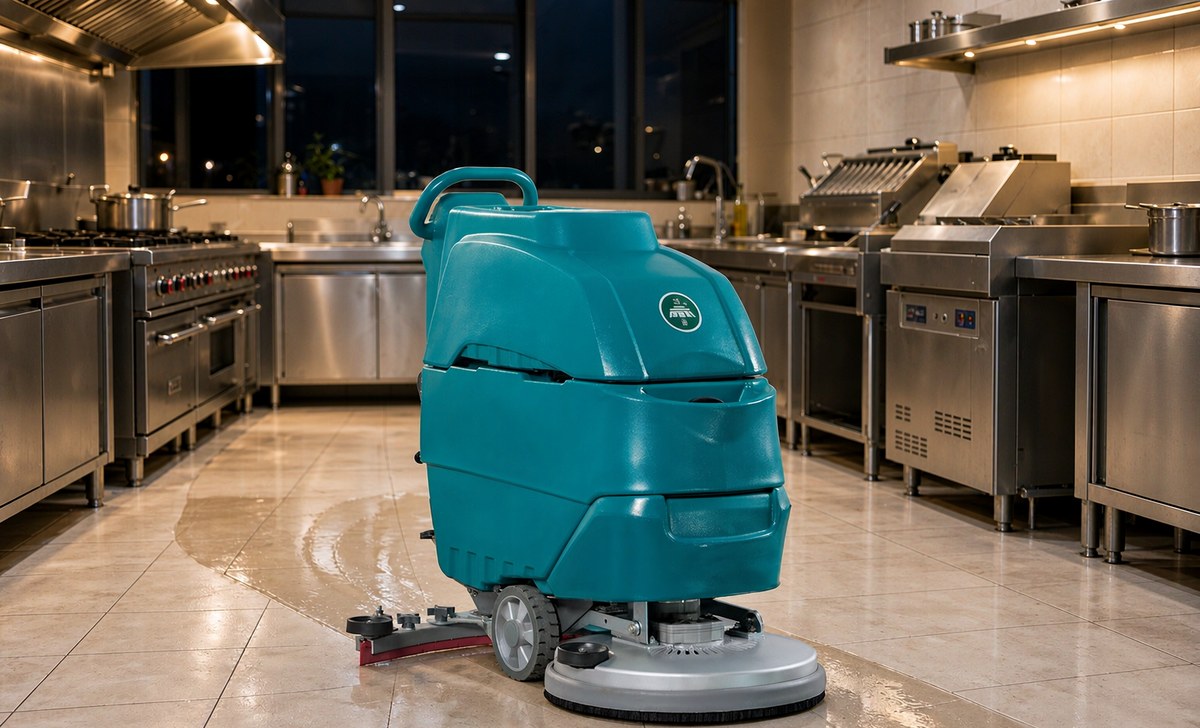
Kitchen and food service work sits near the top of slip-claim statistics in most countries, Kitchen and canteen floors fail in a specific way. They look acceptable from the doorway and turn slippery two steps past the fryer, where a thin grease film has been mopped rather than removed.
Dry pick-up first: food scraps, wrappers and anything solid go up before any water touches them, or you end up pushing a slurry around. Then apply degreaser at the dilution the label states, not stronger. Stronger does not clean faster and it leaves its own residue.
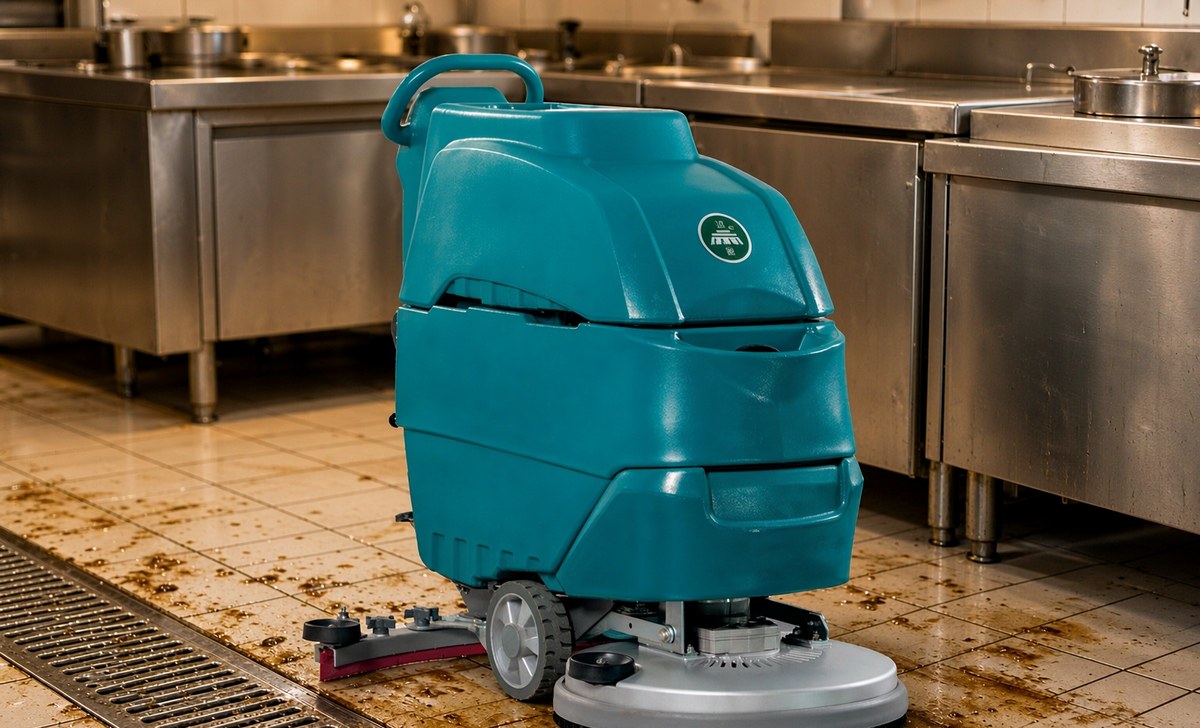
A kitchen floor cannot wait for closing time. Grease from a lunch service is a slip risk by mid-afternoon, and a full degrease cannot run while the line is firing. The answer is short, defined cleans fitted into the gaps the service already has.
| Window | Time | Priority task | Tool |
|---|---|---|---|
| Mid-morning lull | 15–20 min | Spot degrease fryer zone | Deck brush + squeegee |
| Between lunch and dinner | 30–45 min | Full scrub of kitchen floor | Compact scrubber dryer |
| After close | 60–90 min | Full degreasing sequence + drains | Scrubber + wet vacuum |
| Weekly | Half shift | Equipment bases, corners, grates | Detail tools |
Post the table at the pot wash. A between-service clean that depends on someone noticing the floor is a clean that happens on the day somebody slips instead.
Most cleaning machines are built for lobbies, not for a galley kitchen with two metres between the range and the wall. A canteen cleaning machine has to turn in the aisle, pass through a standard door, and leave the floor dry enough to walk on when service restarts.
A compact scrubber such as the JIECHI A3 walk-behind scrubber or its self-propelled sister model, the A3D, answers that. They share the same core platform, which makes the choice between them a working-condition decision rather than a specification fight.
| Item | JIECHI A3 | JIECHI A3D |
|---|---|---|
| Drive | Operator-pushed | Self-propelled |
| Battery | 24 V / 100 Ah | 24 V / 100 Ah |
| Brush / suction width | 530 mm / 770 mm | 530 mm / 770 mm |
| Rated output | 2,200 m²/h | 2,400 m²/h |
| Tanks, fresh / recovery | 50 L / 55 L | 50 L / 55 L |
| Brush / vacuum motor | 550 W / 550 W | 550 W / 550 W |
| Size / weight | 127×55×109 cm, 155 kg | 127×55×109 cm, 165 kg |
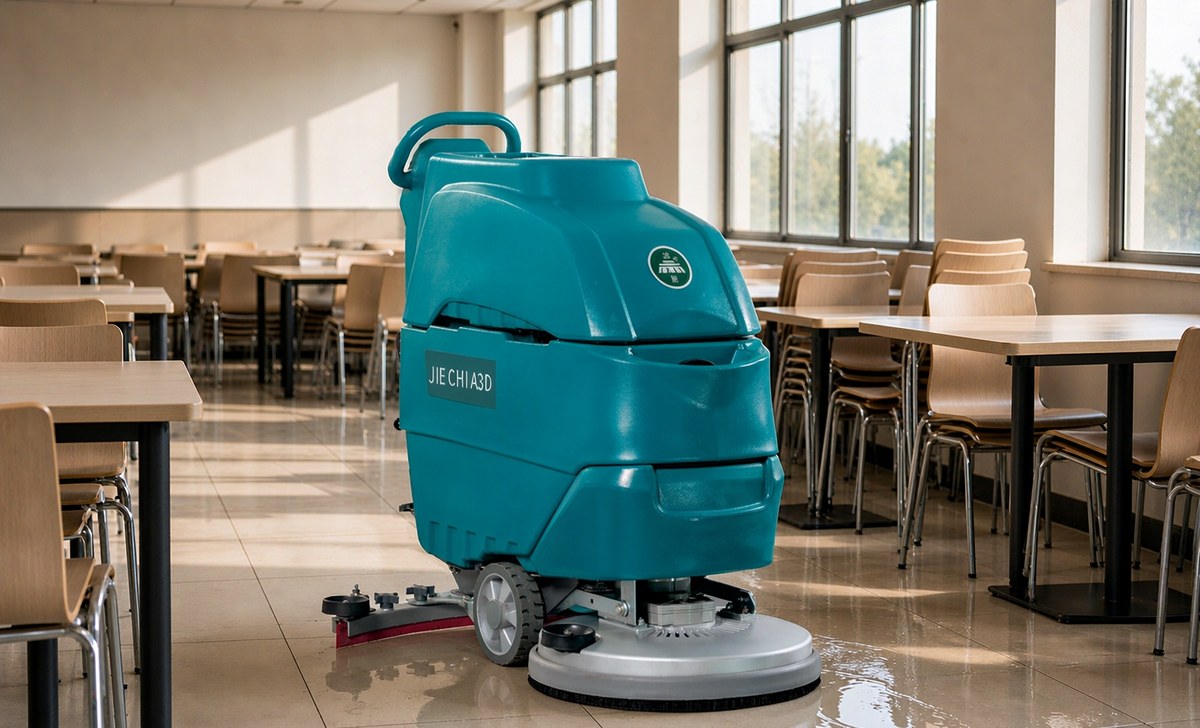
Take a kitchen plus canteen floor of around 400 m². At the A3's rated 2,200 m²/h the pass is 11 minutes on paper; at a realistic 60 per cent coverage around tables and equipment it is closer to 18 to 20 minutes, which fits the lunch-to-dinner window. Shanghai Jiechi builds both versions on the same platform, so spares, brushes and training carry across the fleet.
Which one should a small kitchen buy, the A3 or the A3D?
For one compact kitchen the A3 usually covers it: push operation plus adjustable brush pressure for baked-on grease. Move to the A3D for long pot-wash-to-canteen routes, tight aisles, or the built-in high-pressure jet for stubborn spots.
What should the floor look like after a correct clean?
Matte and dry, with no sheen under the kitchen lights. A glossy tile floor in a kitchen is a warning sign, not a result; that shine is usually the residue the routine failed to rinse away.
Tell us the floor area, the tightest aisle and your service windows. We will match a compact scrubber and slurry vacuum to the routine.
Tel: +1 2403149021 | Email: kliu@jiechi.com | www.rceautofloorclean.com

 Phone:+1 2403149021
 Email:kliu@jiechi.com

leave a message
Scan To Wechat :

Scan To WhatsApp :

 English


