other

Equipment Selection

Home

Equipment Selection

  • 7 Signs Your Factory Needs A Professional Floor Cleaning Machine
    Aug 11, 2026
    If your factory floors are never truly clean, cleaning eats too many labor hours, or slip incidents keep happening, it's time to upgrade to a professional floor cleaning machine. Here are 7 clear signs that manual cleaning no longer works for your facility. Sign 1: Cleaning Takes Too Long If your crew spends hours mopping and the floor still isn't clean, you're wasting labor. A professional floor cleaning machine covers 10–20x more area per hour than a mop. Sign 2: Floors Stay Stained No Matter What Oil, grease, and tire marks that resist mopping are a clear signal. Scrubbers use brush pressure and detergent to remove embedded soil that mops simply spread around. Sign 3: Cleaning Labor Costs Keep Rising Labor is your biggest cleaning expense. One scrubber operator replaces 2–3 manual cleaners — and machines don't take breaks. Sign 4: Slip Accidents Keep Happening Wet floors from mopping are a top cause of workplace slips. Scrubbers scrub and vacuum dry in one pass, leaving floors dry and safe within minutes. Sign 5: Dust Affects Product Quality In manufacturing, airborne dust and tracked-in dirt contaminate products and machinery. Mechanized cleaning controls dust better and keeps production areas cleaner. Sign 6: Cleaning Results Vary Between Shifts If day and night shifts produce different cleaning quality, your process depends too much on individual effort. Machines deliver consistent results every pass. Sign 7: Your Old Equipment Keeps Breaking Down Frequent repairs on aging scrubbers cost more than replacing them. Newer models offer better batteries, stronger suction, and lower maintenance. FAQ Q: How do I justify buying a floor cleaning machine for my factory?A: Calculate current cleaning labor hours and cost, then compare with one machine + operator. Most factories see payback within 6–18 months. Q: What size machine does a mid-size factory need?A: A walk-behind scrubber suits floors under 5,000㎡. A ride-on model is better for 5,000㎡+ open production areas. Conclusion If any of these 7 signs sound familiar, your factory has outgrown manual cleaning. Jiechi offers a full range of walk-behind and ride-on floor scrubber machine Factory options designed for demanding production floors — trusted by 3,000+ industrial facilities and 100,000+ customers worldwide. Contact Jiechi ? Website: www.rceautofloorclean.com ? Phone: +1 2403149021 ✉️ Email: kliu@jiechi.com ? LinkedIn: Jiechi Cleaning Equipment ? Facebook: Jiechi Cleaning Equipment
  • How To Choose The Right Floor Scrubber For A Manufacturing Facility?
    Jul 28, 2026
    Choosing the right floor scrubber for a manufacturing facility comes down to four factors: floor area, surface type, soil level, and shift schedule. Match machine size to your space, brush type to your floor, and battery type to your runtime needs. Key Takeaways- ? Floor area determines size — under 5,000㎡ → walk-behind; 5,000–15,000㎡ → small ride-on; over 15,000㎡ → large ride-on- ? Concrete needs aggressive brushes — epoxy floors need fine pads to avoid scratching- ?️ Heavy oil/grease requires dual-tank systems for detergent + rinse passes- ? Lithium batteries suit multi-shift factories; lead-acid works for single-shift- ? Look at total cost of ownership, not just purchase price Floor Area Under 5,000㎡: A walk behind floor scrubber is practical and cost-effective. 5,000–15,000㎡: A small ride-on (600–700mm scrubbing width) balances speed and maneuverability. Over 15,000㎡: A large ride-on (800mm+) maximizes productivity. Surface Type Smooth concrete needs medium-grit brushes. Epoxy or coated floors need fine pads — wrong pads cause scratches that trap dirt. For rough or pitted concrete, heavier brush down-pressure is essential. Soil Level Light dust → single-pass scrubbing works. Heavy oil, grease, or metal shavings → choose a machine with dual-tank system for detergent scrub + clean water rinse. For loose debris, consider a sweeper-scrubber combo. Battery & Runtime Single-shift (4–6 hours) → lead-acid is reliable and lower cost. Multi-shift or opportunity charging → lithium batteries charge faster, last longer, and need no water maintenance. A battery-powered walk-behind floor scrubber is a great entry point for smaller factories. Key Specs Checklist Factor What to Look For Scrubbing width Match to aisle width Tank capacity 2–3 fills per shift minimum Brush pressure Adjustable for different soils Water recovery Strong vacuum for fast drying Service access Easy brush/squeegee changes FAQ Q: Should I choose a walk-behind or ride-on scrubber for my factory?A: Walk-behind for tight spaces and areas under 5,000㎡. Ride-on for open floors over 5,000㎡ — operators clean faster with less fatigue. Q: What battery is best for a 24-hour manufacturing facility?A: Lithium. They charge in 2–3 hours, support opportunity charging during breaks, and last 2–3x longer than lead-acid in cycles. Conclusion The right floor scrubber for your manufacturing facility depends on your space, floors, dirt, and schedule. Jiechi offers a full range of walk-behind and ride-on industrial floor scrubber machines — from compact models for tight workshops to large units for production floors — backed by over 3,000 industrial facilities served and 100,000+ customers worldwide.

  • Why "Clean Enough" Is Killing Your Factory's Long-Term Efficiency
    Jul 07, 2026
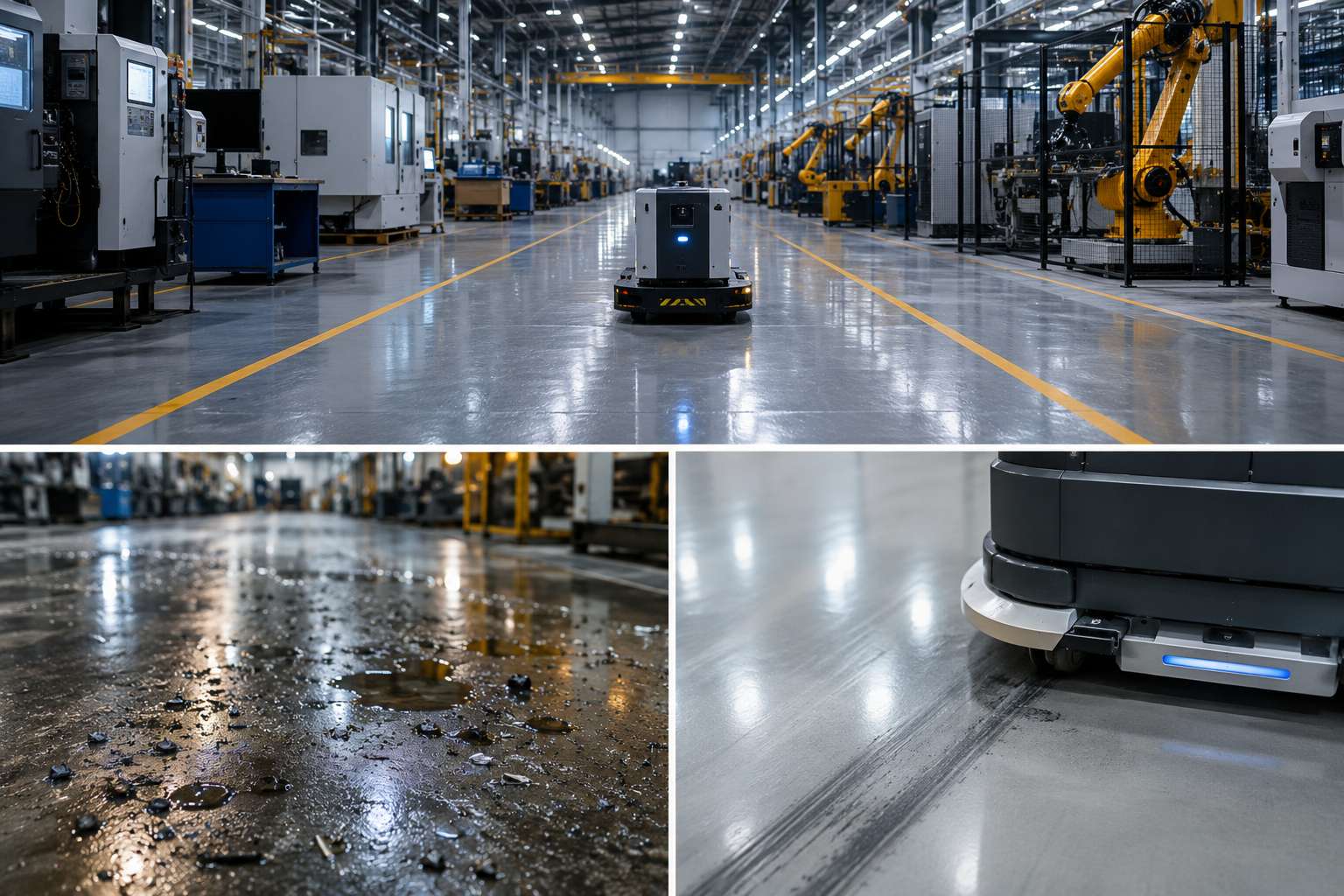
    Most factory managers share one quiet mindset.They don't aim for perfect floors.They aim for clean enough.Clean enough for production to run.Clean enough to pass daily inspections.Clean enough to avoid obvious safety hazards. On the surface, this logic makes sense.But in manufacturing, "good enough" is one of the slowest, most expensive operational mistakes a facility can make.Because "clean enough" creates invisible drift.Small issues stay unaddressed.Over weeks and months, they accumulate into larger problems that hurt safety, productivity, and equipment lifespans. "Clean Enough" Is How Operational Standards Slowly Decline Factory standards never collapse in one day.They erode gradually.A small oil stain that gets ignored today becomes a permanent patch tomorrow.Debris that is "fine for now" slowly builds into cluttered walkways.Dust that nobody bothers to remove begins circulating into machines and electrical panels. Each individual issue feels negligible.So teams keep choosing "clean enough."But operational discipline is like a baseline.Once you accept minor exceptions, the baseline shifts downward.Soon, what was once unacceptable becomes normal.That's how factories slowly lose consistency — even when no single crisis ever occurs. In Smart Factories, "Clean Enough" Is Never Enough Manual work can tolerate inconsistency.Humans can adapt to dusty floors, minor spills, or scattered debris.Automation cannot. AGVs and AMRs operate based on fixed parameters.They rely on consistent traction, clear routes, and predictable floor conditions.When your standard is only "clean enough": Sensors collect more dust, causing inaccurate navigation Minor floor residue creates subtle friction issues Hidden debris triggers unplanned stops Slight uneven contamination accumulates and shortens machine life Human workers can compensate for messy environments.Automation exposes every inconsistency.The moment your factory adopts smart equipment, your definition of clean must evolve — from visual cleanliness to operational consistency. The Hidden Cost of Settling for "Good Enough" Companies track obvious costs: downtime, material waste, labor overtime.But they rarely track the cost of inconsistent cleanliness.These costs live in the gaps: Frequent sensor calibration Premature wear on robotics components Unplanned forklift slowdowns Extra labor spent correcting messy work zones Lower pass rates during customer and third-party audits Higher probability of slips, trips, and near-miss incidents None of these appear as major line items.But they compound every single shift.Over a year, "clean enough" easily costs facilities tens of thousands in hidden operational loss. Consistency Is Cheaper Than Correction Many facilities resist standardized cleaning because they see it as "extra work."They believe occasional cleaning saves time and labor.The opposite is true. Reactive cleaning always costs more than preventive cleaning.When you only clean when problems appear: You clean inefficiently You clean under pressure You clean after damage is already done When you maintain consistent floor conditions — supported by reliable equipment from a trusted floor cleaning machine Factory — you: Prevent equipment wear before it starts Eliminate most safety risks in advance Keep workflows predictable for both staff and automation Maintain stable audit-level standards every day In manufacturing, consistency is not perfection.It's cost control. The Difference Between "Cleaning" and "Maintaining" This is the key mindset shift that separates average factories from world-class ones.Most facilities do cleaning.Top facilities do floor condition maintenance. Cleaning removes visible dirt.Maintenance preserves stable, repeatable operating conditions.One is cosmetic.The other is operational. For modern smart factories, floor maintenance is no longer housekeeping.It's core operational management. We've observed a clear divide between high-performing facilities and average ones.It does not come down to equipment budget.It comes down to standard tolerance. Struggling factories tolerate small inconsistencies.Leading factories eliminate them. The best operators understand this:Your floor's daily condition sets the ceiling for your operational stability.

leave a message

leave a message
If you are interested in our products and want to know more details,please leave a message here,we will reply you as soon as we can.
submit

Home

Products

WhatsApp

contact